
The Technology Works. The Law Is Still Catching Up.
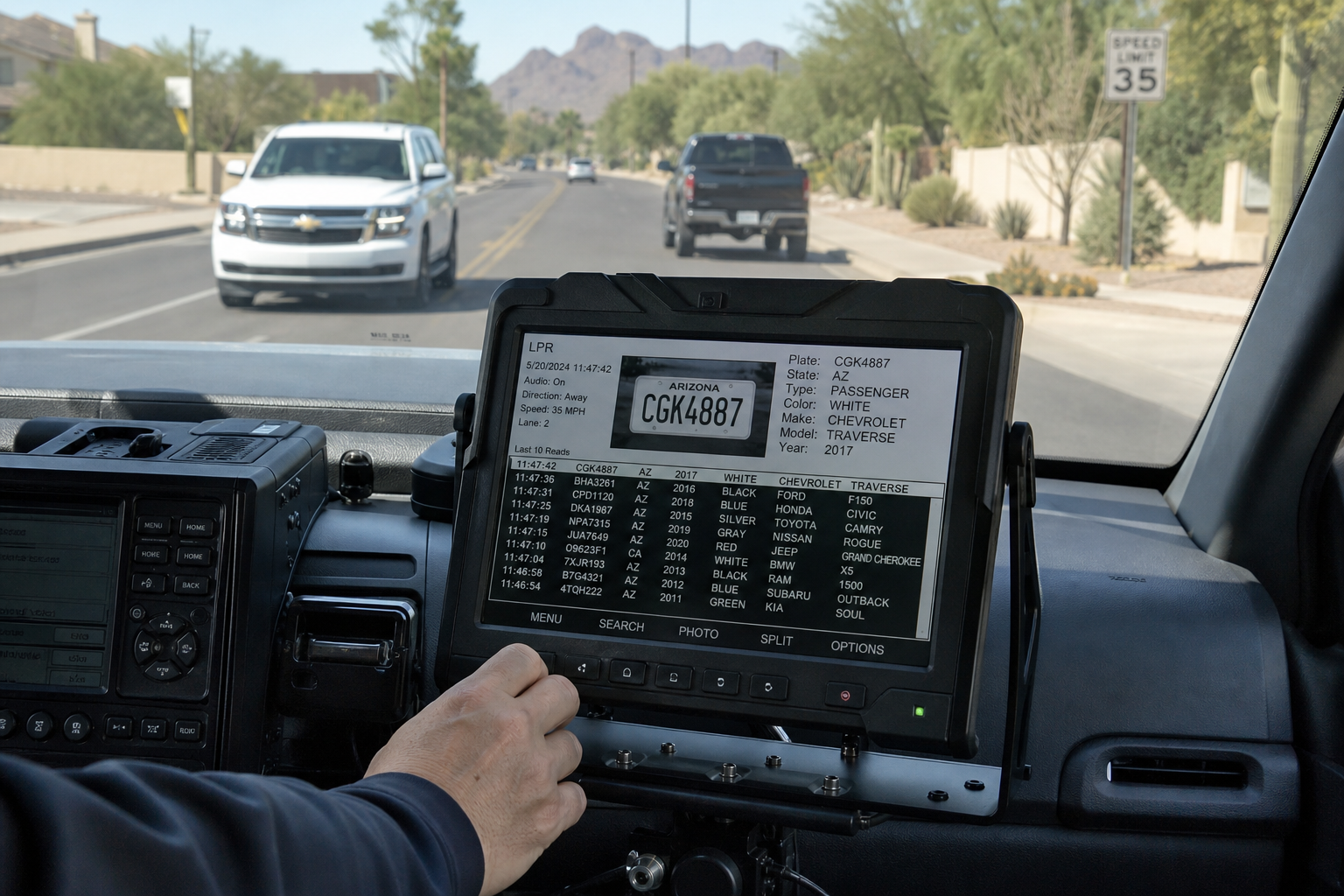
A camera mounted on a police cruiser or a utility pole can capture and digitize thousands of license plates per hour. It runs them against databases of stolen vehicles, missing persons, and vehicles connected to criminal investigations. When there is a match, dispatch receives an alert.
This is efficient. It finds stolen cars. It locates vehicles connected to amber alerts. In a state as large as Arizona, with a southern border and interstate corridors carrying drug traffic and human smuggling, the practical value is real.
But efficiency is not the same as lawfulness, and a tool that works is not automatically one you get to keep using forever without limits.
What the Data Actually Reveals
License plate readers do not just capture plates of stolen vehicles or fugitives. They capture every plate that passes within camera range. A single reader scanning a highway for eight hours captures data on thousands of vehicles driven by ordinary people commuting to work, visiting family, or making routine errands.
When that data is stored—and it is, sometimes for years—it creates a geographic and chronological record of where your vehicle has been. Cross-reference enough readers, and you have a map of your movements. You have not been arrested. You have not been suspected of a crime. But the government has a record anyway.
The Fourth Amendment protects against unreasonable searches. The question is whether mass collection of location data without individualized suspicion qualifies as a search at all, and if so, whether it is reasonable.
Arizona's Approach and the Gaps
Arizona law enforcement agencies use license plate readers widely. Most police departments in Maricopa County operate them. The Department of Public Safety runs them on major corridors. Some agencies have published their policies on use and data retention. Others have not.
That inconsistency matters. If one agency deletes reader data after 90 days and another keeps it for five years, you have different legal standards within the same state. That should not be how constitutional protections work.
Arizona statute does not mandate statewide policy on LPR use. There is no requirement that data be deleted on a fixed schedule. There is no law requiring a warrant before searching historical location data. There is no statute defining which crimes justify running a query against years of accumulated plate scans. The technology is there. The legal guardrails are not.
The Conservative Case for Limits
Conservatives believe in a secured border and effective law enforcement. Arizona law enforcement needs tools to work with. No one benefits from making the Border Patrol's job harder or from handicapping local police investigating stolen vehicles or violent crime.
But constitutional limits are not obstacles to overcome. They are boundaries that prevent power from metastasizing. A government that can track your location without a warrant or probable cause has power over you that you did not consent to. The Second Amendment exists partly because the founders understood that unchecked government power tends not to stay checked.
License plate readers are only problematic if their use is unlimited. They become dangerous when data accumulates without restriction, when queries happen without suspicion, and when there is no legal recourse if the data is used against you incorrectly.
The solution is not to ban the technology. It is to write the law that governs it.
What Arizona Should Do
First, establish a statewide baseline. Every agency operating readers should follow the same data retention schedule. Ninety days is reasonable. Five years is not. Data collected without probable cause should not sit in a database indefinitely waiting for retroactive justification.
Second, require that historical searches—looking back at months or years of plate data—require either a warrant or authorization from a supervisor with specific articulable facts about the investigation. Do not make it impossible. Make it auditable. Make someone responsible for the decision.
Third, mandate that agencies report quarterly on the number of queries run, the number of matches obtained, and how many of those matches resulted in criminal charges. You cannot hold anyone accountable for abusing a system if you do not know how often they use it.
Fourth, establish a suppression remedy. If an officer uses plate reader data in violation of the statute, the evidence should be inadmissible. That is how you enforce the law against law enforcement.
These are not radical demands. They are the framework that ought to exist before a technology becomes as routine as it already is.
The Calendar and Your Action Item
Arizona's Legislative Session began in January. Bills addressing surveillance technology and data retention rarely come up unless someone forces the issue. You should contact your representative and your senator before the end of the month and ask them directly: Does your bill require a warrant or supervisor authorization for historical license plate searches?
If they tell you they have not thought about it, or if they tell you law enforcement has not asked them to, then you have your answer about whose interests are being protected.
The technology will only become more widespread. The time to establish limits is now, not after a decade of unchecked collection makes the conversation impossible.
