
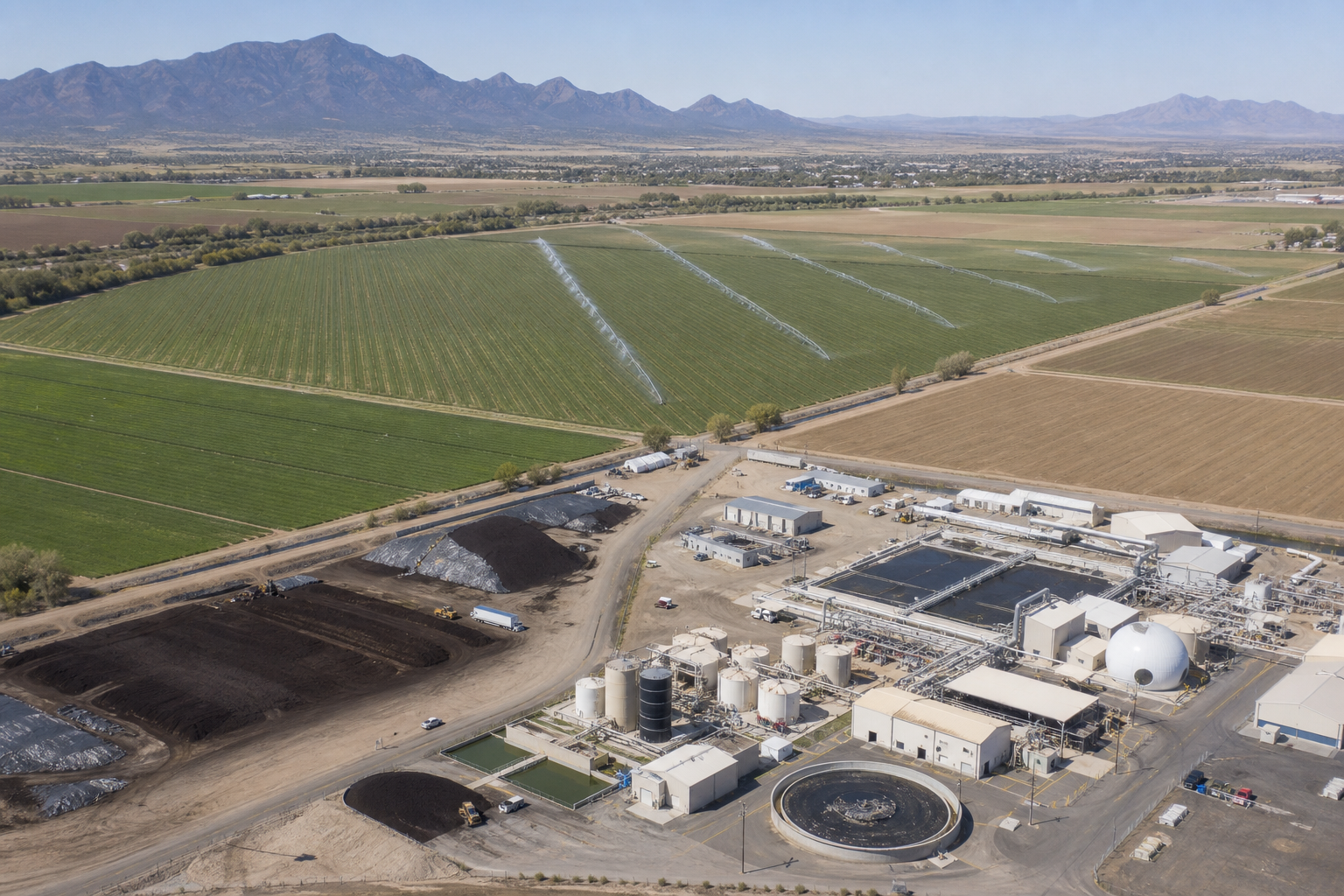
State Suspends Biosolids Leasing Program Amid Chain-of-Custody Questions
The Arizona Department of Environmental Quality halted new leases for land application of biosolids last week. Biosolids are treated sewage sludge that municipal wastewater plants remove from treatment ponds and sell or give to farmers as a soil amendment.
The suspension is not a temporary pause. It is an admission that the state cannot verify what is in the material it has been allowing on farmland for the better part of two decades.
Here is what happened. A contractor hired to audit the state's biosolids program found that tracking documents — the forms that are supposed to follow sludge from the treatment plant through land application and into the soil — contained errors, missing information, and inconsistencies. Some shipments lacked proper certification. Some application sites were not documented at all. The state could not produce a complete inventory of where biosolids had been applied or what contaminants they contained.
You live in Arizona. This matters to you whether you farm, own property downwind of application sites, or simply depend on groundwater that may eventually migrate through soils where untreated sewage sludge has been spread.
What Biosolids Are and Why the Program Exists
Municipal wastewater treatment plants remove solids from the water they process. Those solids contain organic material, but also heavy metals, pharmaceuticals, microplastics, and pathogens. Historically, these solids went to landfills. In the 1990s, the EPA began promoting land application as a cost-saving alternative. Treat the sludge enough to kill the most dangerous pathogens, and you can spread it on agricultural land as fertilizer.
Arizona embraced the practice. Cities like Phoenix, Tucson, and Chandler began contracting with private operators to apply biosolids across thousands of acres in rural Pinal, Cochise, and Yavapai counties. The benefit to cities was obvious: they avoided landfill tipping fees. The benefit to farmers was supposed to be nitrogen and organic matter. The cost was borne by landowners who agreed to allow application, by neighbors adjacent to those lands, and by anyone whose water table sat below them.
The program operated under state rules that required documentation and periodic testing. In theory, that created accountability. In practice, the audit found, the state never enforced the documentation requirements with any consistency.
The Audit Revealed What Happened When Oversight Failed
According to the audit summary released by DEQ, inspectors found:
- Biosolids application sites where no permit file existed
- Tracking documents missing required contaminant testing results
- Shipment records showing discrepancies between volume applied and volume reported
- Certification forms signed by individuals no longer employed by the applicator company
- No documented verification that operators were actually applying material to the sites listed on their permits
This is not a regulatory technicality. Chain of custody is the mechanism that allows you to know what is being put in the ground and where. Without it, you have material of unknown origin and composition being distributed across farmland by operators with minimal oversight.
The state's response has been to freeze new leases pending a review of the existing program. That is prudent. It is also decades late.
Why Biosolids Contamination Matters in Arizona
Arizona depends on groundwater for roughly 40 percent of its water supply. Much of that comes from active management areas in Pinal and Pinal counties, where municipal and agricultural pumping has already drawn down aquifers. The state regulates how much water can be pumped from these basins, but it has far less control over what gets put into the soil above them.
Biosolids contain substances that persist in soil and groundwater. Heavy metals like cadmium and lead do not degrade. Pharmaceuticals, estrogens from birth control, and flame retardants from municipal waste accumulate in soils. Some can leach downward into aquifers. Others move laterally through groundwater and contaminate wells miles away from the original application site.
Arizona has limited data on where contamination from biosolids has actually occurred. That is by design. If the state does not comprehensively test groundwater near application sites, it cannot be sued for damages. If it does not require operators to post application maps and contaminant results, the public cannot independently verify the program's safety.
You cannot manage what you do not measure. Arizona did not measure.
What Comes Next — and What Should
DEQ says it will conduct a full audit of existing biosolids applications and review its permitting process before restarting new leases. That process will take months. Operators who have profitable contracts in place will lobby to get them reinstated as soon as possible, audit or no audit.
Your state representatives need to hear from you before that happens. You should demand four things:
- A complete public inventory of every biosolids application site in Arizona, with exact coordinates and application dates
- Mandatory contaminant testing at every site, with results posted online before material is applied
- Groundwater testing at all active management area wells within five miles of any application site
- A statutory requirement that biosolids programs are reauthorized every five years by legislative vote, not simply allowed to continue under administrative rule
None of this is complicated. It is the baseline for any program that puts unknown substances into soil above your water supply.
Contact your state representative and ask where they stand on making those four requirements law. Get a specific answer. Write it down. Remember it in August when you vote in the primary.
