
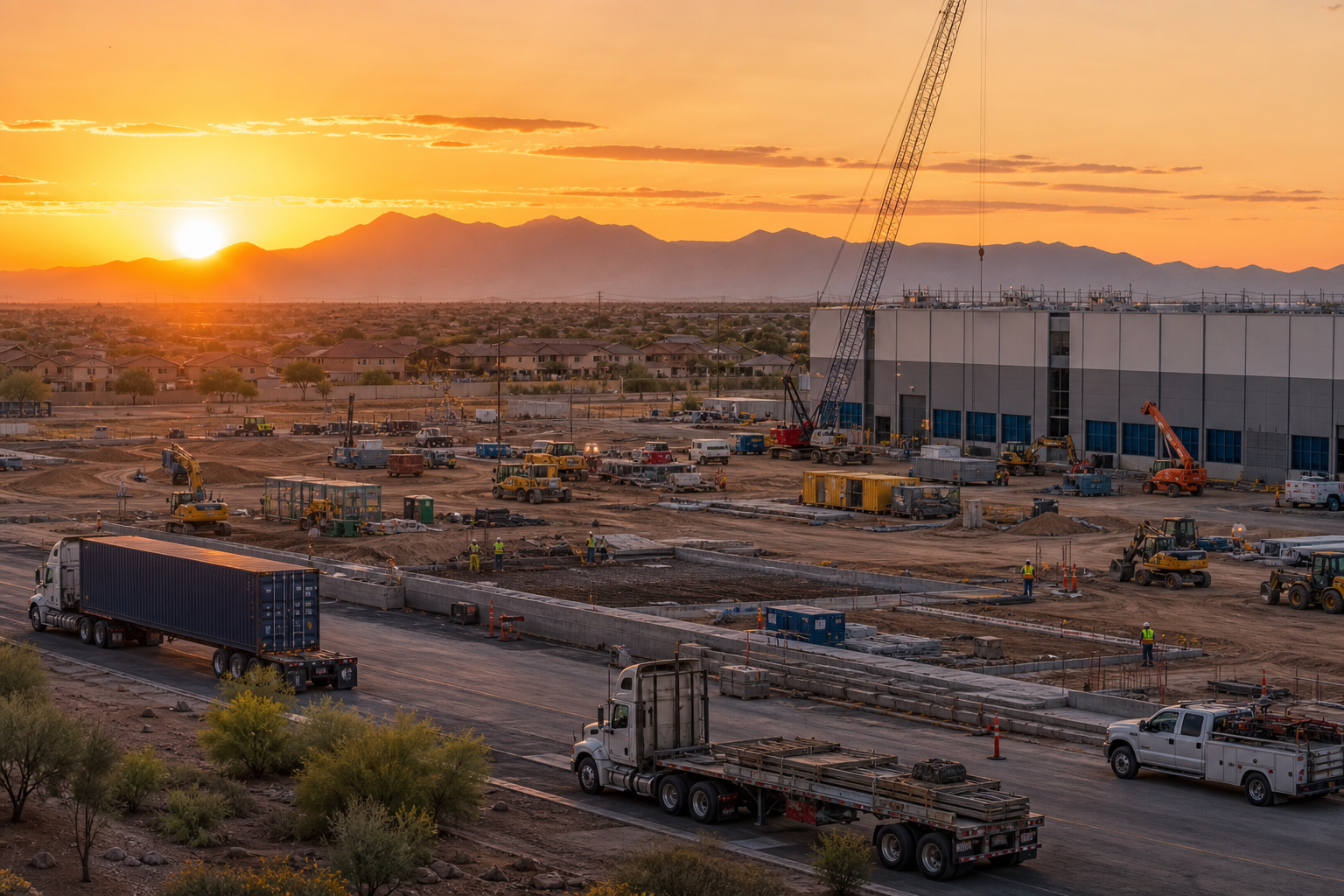
Arizona is adding jobs faster than much of the country, and the usual people are trying very hard not to say why.
This is not a mystery. It is policy.
When employers choose between Arizona and California, or Arizona and Illinois, they are not flipping a coin. They are looking at tax burdens, permitting timelines, labor costs, energy reliability, land availability, and whether state government treats investment as a target or a partner. Arizona has spent years making a clearer offer than many competing states. You can see the result in payrolls, warehouse districts, semiconductor campuses, and the steady expansion pushing down roads in the East Valley and along Interstate 10.
What Is Driving Arizona Job Growth
Start with migration. People are still moving to Arizona for a simple reason: opportunity paired with a lower cost structure than the coastal states they are leaving. Some come as retirees. Many come as workers. Others bring businesses with them. That matters because job growth does not happen in a vacuum. It follows people, capital, and confidence.
Then there is the tax and regulatory picture. Arizona has generally maintained a more competitive posture than high-tax blue states. For years, the state sold predictability. Employers could model costs. Builders could plan projects. Manufacturers could look at Arizona and believe the state wanted them there. That kind of stability does not make for dramatic press conferences, but it matters far more than slogans.
The state has also benefited from sector diversity. Arizona is not living on one industry. It has logistics, construction, health care, advanced manufacturing, tourism, data infrastructure, and a growing technology footprint. Semiconductor investment in particular has drawn national attention, but it sits inside a broader ecosystem. Suppliers follow anchor projects. Construction jobs follow suppliers. Service employment follows rooftops. One major facility does not just create one line on a spreadsheet. It creates a chain.
Lower-Tax Competition Still Matters
This is the part progressives like to wave away. They should not.
States compete. They compete for jobs. They compete for families. They compete for investment. Arizona has won some of that competition because it did not copy the governing model of Sacramento.
That means a relatively lighter tax burden. It means a legal and regulatory culture that has, at its best, treated private employers as the source of prosperity rather than the object of suspicion. It means a right-to-work environment that many companies still consider a major advantage. It means faster growth at the edge of metro areas where land can still be developed at scale.
None of this means every policy choice in Phoenix has been wise. Far from it. Republicans in this state have often talked a better growth game than they have governed. But the broad structure still matters. Even unevenly applied pro-growth policy beats managed decline.
The Border, Logistics, and Arizona's Geographic Edge
Arizona also benefits from geography. Interstate 10 is not theoretical. Interstate 8 is not theoretical. Union Pacific lines, warehousing corridors, and proximity to California markets are not theoretical. They are the physical skeleton of the state's logistics economy.
But geography by itself is not enough. A state can sit on a trade route and still misgovern itself into stagnation. Arizona's advantage works when public policy supports movement of goods, freight reliability, industrial siting, and workforce growth. In Yuma, Pinal, Pima, and Maricopa counties, that equation is visible on the ground.
There is also a border reality here that polite national coverage often misses. A secure and orderly border is not separate from economic policy. It is economic policy. Businesses need lawful labor markets, secure transport corridors, and a government capable of basic sovereignty. Cartel disorder, migrant surges, and federal management failures impose real costs on local communities and employers alike. A nation that cannot control entry cannot guarantee stability. That is not rhetoric. It is operations.
Why Housing and Energy Will Decide Whether the Surge Lasts
Here is the warning light.
Arizona can grow itself into trouble if lawmakers and local governments decide success means they can stop doing the things that produced it. Job growth is easier to celebrate than to sustain.
Housing is the first pressure point. When a state attracts workers faster than it adds attainable housing, wages get eaten by rent and commuting costs. That does not just hurt families. It hurts employers trying to fill jobs. Local zoning fights, permitting delays, and infrastructure bottlenecks can quietly do the work of an economic slowdown before the official numbers catch up.
Energy is the second pressure point. Arizona's growth model requires reliable power. Full stop. Data centers require power. Chip manufacturing requires power. New suburbs require power. If the state follows the green-slogan approach of states that undermine baseload generation before replacements are ready, the bill will come due fast. Reliable electricity is not optional infrastructure. It is the condition for expansion.
Then there is water. In Arizona, every growth conversation ends there sooner or later.
Water Policy Will Make or Break the Next Decade
You cannot discuss Arizona growth honestly without discussing groundwater, Colorado River uncertainty, and the state's increasingly hard choices around development. If state leaders want the job surge to continue, they need to handle water law with more seriousness than press-release politics usually allows.
The real challenge is not whether Arizona should grow. It will. The question is whether state government can align growth with supplies, conservation, storage, and transparent rules that do not change halfway through the game.
Business hates uncertainty more than bad news. Tell investors the rules and they can price them. Change the rules through agency drift, opaque modeling, or last-minute political improvisation, and they start looking elsewhere.
Arizona needs a water policy that is honest, enforceable, and stable. Rural counties need to know what protections they have. Urban builders need clarity. Employers need confidence that infrastructure planning is real. This is not anti-growth. It is the only way growth lasts.
The Conservative Lesson
Arizona's job gains are a reminder that states still matter. Policy still matters. Federal headlines dominate cable chatter, but governors, legislators, county boards, utility regulators, and city councils decide much of what shapes daily economic life.
Lower barriers to investment matter. Predictable rules matter. School quality matters. Public safety matters. So do roads, water, and energy. A government that can do the basics well will usually beat one that treats ideology as a substitute for competence.
Conservatives should take the win, but they should not get lazy about it. Growth is not a birthright. It is rented, and the rent is due every legislative session.
If Arizona Republicans want to keep talking about economic strength, then they need to protect the actual conditions that produce it: competitive taxes, disciplined regulation, reliable power, serious water planning, public safety, and a border the federal government does not leave in chaos.
That is the formula. Not magic. Not branding. Policy.
And if Phoenix forgets that, the jobs can find another map.
