
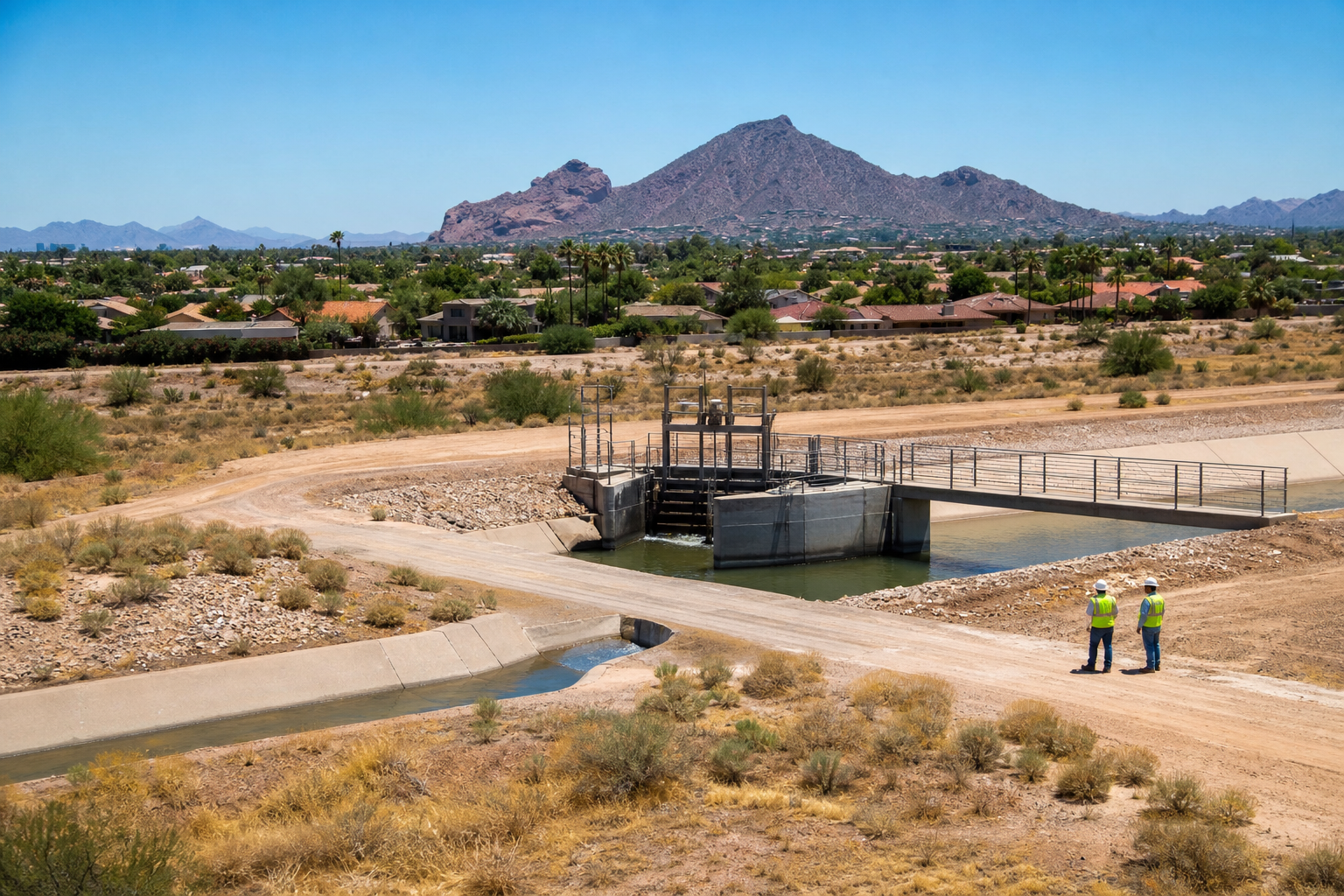
Scottsdale is not waiting for the next Colorado River cut to start thinking about water. It is already planning around it. That is the right instinct, because Arizona’s water problem is no longer theoretical, and it is no longer something you can push onto the next city council.
The basic fact is simple. Scottsdale, like much of central Arizona, depends in part on Colorado River supplies delivered through the Central Arizona Project. Those supplies have already taken reductions under the river shortage system. More pressure could come if reservoir levels continue to fall and if the states on the river fail to agree on a durable post-2026 operating framework.
That is the backdrop for every local water meeting in this state now, whether elected officials admit it plainly or not.
What Scottsdale is trying to do
Scottsdale’s strategy is not built on one silver bullet. It is built on a familiar Arizona mix: diversify supplies, stretch existing water, bank what you can, and make sure demand does not outrun reality.
That means conservation programs. It means wastewater recycling. It means closer management of groundwater and stored supplies. It means planning for capital improvements before a crisis forces expensive emergency decisions.
It also means a harder conversation about growth.
In Arizona, water policy always ends up at the same doorstep. Can you keep approving new demand faster than you secure dependable supply. That is not a partisan question. It is arithmetic.
Scottsdale has some advantages. It has a sophisticated municipal water system. It has experience with water reuse and conservation. It has the kind of tax base that can support serious planning. But none of that changes the larger regional fact. If Colorado River supplies shrink further, every city that relies on them will face tighter choices.
The Colorado River problem is bigger than one city
This is where the politics usually get slippery. Local officials like to talk as if their city can engineer its way out of a basin-wide shortage. They cannot.
The Colorado River system has been under stress for years from over-allocation, drought, and declining reservoir levels. The federal government, the seven basin states, tribes, irrigation districts, and municipal providers have all been fighting over the same shrinking pie. Arizona has already absorbed painful cuts, especially through the CAP system, because of the state’s junior priority relative to California’s senior rights in many circumstances.
That is the deal Arizona signed. You do not improve it by pretending it does not exist.
Scottsdale’s planners know this. So do water managers across Maricopa and Pinal counties. The question is whether state and local elected officials will tell voters the whole truth. Water security now depends not just on conservation slogans, but on land-use discipline, infrastructure spending, and clear limits.
Conservation matters, but it is not magic
Conservation is the easiest part of the message politically. Everybody supports efficiency in the abstract. Low-flow fixtures. Turf reduction. Smarter irrigation. Leak detection. Public education. Fine. Do all of it.
But conservation has limits. You can only squeeze so much out of residential use before the bigger structural questions come back. In Arizona, agriculture still uses the largest share of water statewide, though cities and subdivisions tend to dominate the politics because that is where voters see permits, rooftops, and rising utility bills.
For Scottsdale specifically, conservation can buy time and improve resilience. It cannot replace lost river water by itself.
That is why wastewater reuse and recharge matter so much. If a city can treat water, reuse it, and bank supplies underground when conditions allow, it builds a buffer. Not a miracle. A buffer. In Arizona water policy, buffers matter. They are often the difference between a manageable shortage and a public panic.
The growth question will not go away
Here is the part state officials and developers prefer to blur. Water planning is not just a utility issue. It is a growth issue.
If a city expects reduced Colorado River reliability, then every major development decision has to be tested against that fact. You do not protect current residents by making promises to future residents you cannot keep. That should be obvious. In this state, it often is not.
Arizona learned this lesson again when state regulators concluded there was not enough groundwater available to support some proposed development in parts of the Phoenix Active Management Area under current assumptions. That sent a shock through the housing and land markets, as it should have. Water first. Then permits. Not the other way around.
Scottsdale is not identical to those cases, but it operates inside the same regional stress. Any serious city strategy has to ask whether supply portfolios remain reliable under worse river conditions, not just under optimistic models.
This is where conservative governance should be better than what we usually get. Real conservatism is not boosterism with a chamber of commerce lapel pin. It is stewardship, limits, and honesty about physical reality. A desert city should be run like a desert city.
Who pays for adaptation
There is also the taxpayer question. Every adaptation path costs money.
New treatment capacity costs money. Distribution upgrades cost money. Recharge projects cost money. Water acquisition costs money. Public messaging campaigns are cheap by comparison, which is one reason governments love them.
You should ask who pays, when they pay, and whether the city is making choices now that avoid larger costs later. You should also ask whether current ratepayers are subsidizing political hesitation.
Because delay is not free. Delay just hides the bill.
If Scottsdale invests early in resilience, the city may avoid sharper shocks later. If it waits for federal negotiations or hopes for unusually wet years to save the day, it is gambling with a basic public service. Conservative voters should not need a lecture on that point. You lock in supply before the emergency, not during it.
The state still needs a broader water agenda
Scottsdale can make prudent moves. So can Phoenix, Mesa, Chandler, and other cities with capable utilities. But the state still needs a broader water agenda that is honest about groundwater, rural protections, augmentation, and the terms of future growth.
That means the Legislature cannot keep treating water as a talking point for press conferences and then go soft when the real interests show up. It means the governor’s office cannot substitute process language for policy. It means the Arizona Department of Water Resources has to communicate clearly enough that ordinary residents can understand what is changing and why.
Water fights in this state are often hidden in rulemakings, modeling assumptions, assured water supply determinations, and negotiated agreements that normal people never see. Then the consequences arrive all at once, usually in the form of a halted project, a rate increase, or a local panic about wells.
That is not good government. It is bureaucratic concealment by complexity.
What Scottsdale’s planning tells you
Scottsdale’s preparation is a sign of seriousness. It is also a warning.
The warning is that Arizona’s era of easy assumptions is over. Colorado River water is less certain. Groundwater politics are getting harder. Growth can no longer be discussed as if supply questions are minor paperwork. They are not paperwork. They are the foundation.
If Scottsdale is planning now for a tighter future, other cities should be doing the same, and they should be saying so plainly. No euphemisms. No magic language about sustainability detached from numbers. Just the facts. What supply do you have. What supply could you lose. What projects are underway. What will it cost. And what happens to future development if the river gets worse.
Those are not abstract questions. They reach your water bill, your property value, your housing market, and your tax base.
Arizona has managed to survive in a hard climate because earlier generations built serious systems and took scarcity seriously. The question now is whether current leaders have the same discipline. Scottsdale appears to understand the stakes. The rest of the state should catch up before the next round of cuts does it for them.
