
The Midterm Reckoning
When the 2022 midterms closed, Arizona county election officials faced a question that did not make the news summaries: what went right, and what did not go right, was actually knowable to the public that cast the ballots.
The answer, based on conversations with county officials and a review of their own after-action assessments, is mixed. Some counties performed procedurally sound operations. Others made corrections mid-cycle that should have been caught before Election Day. And nearly all of them discovered that they had built systems that required voters to trust the outcome rather than allowing voters to verify it.
That distinction matters, because it is the difference between a system and a system under siege.
What County Officials Say They Did Right
Chain of custody worked. Equipment was locked down. Ballots were accounted for in reconciliation. When Arizona's largest county ran its hand-count audit after the election, the statistical sample matched the electronic totals within a reasonable margin.
Equipment performed. No major tabulation failures halted the count on Election Night. The vast majority of ballots scanned and sorted without mechanical failure.
Staff were trained to procedure. County officials reported that personnel understood their roles and followed the written protocol rather than improvising at the moment of operation.
These are not small things. Election administration is fundamentally a human-scale process. It depends on people doing what they are supposed to do when they are tired and the world is watching. Counties that made that happen deserve the fact of it on record.
What They Found Was Broken
But they also found gaps that did not close between the 2020 election and 2022.
Signature verification remained subjective. Trainers instructed poll workers to compare voter signatures to the registration card signature. Poll workers then compared them. What constituted a match was left to the judgment of the person holding the two documents. Some workers approved borderline signatures. Others rejected them. No standardized threshold existed. No second reviewer was required. The result: some voters were challenged because of handwriting variation while others with similar variation were waved through.
Precinct-level reconciliation was not public in real time. Counties tallied the ballots, reconciled the counts at the precinct level, and posted the results. But the reconciliation sheets—the documents showing that the number of ballots cast equaled the number of ballots counted—were not posted by precinct on election night. They were published later, often in a format that required a voter to visit the county office or download a PDF. A losing candidate had no way to check the math until after the election was certified. By then, the opportunity to identify and challenge a discrepancy had narrowed considerably.
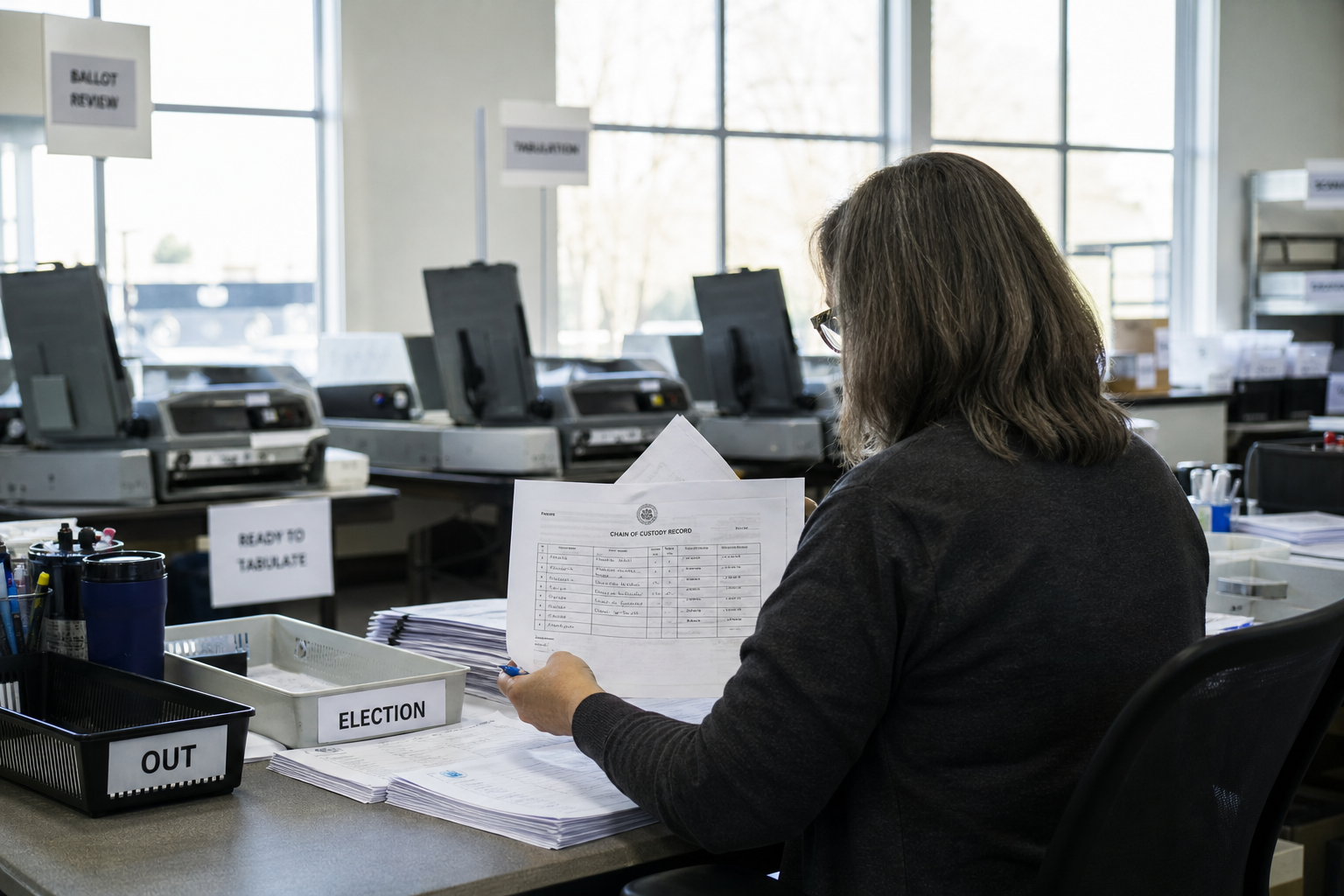
Chain of custody documentation was incomplete in some precincts. Some vote centers did not timestamp the opening and closing of ballot cases. Some did not photograph the security seals before and after transport. Some counties documented the process but did not make those documents available to observers in real time. What was recorded was not visible to the person who had a reason to verify it.
Post-election audits remained limited in scope. Arizona's hand-count audit samples a small percentage of precincts. If a discrepancy appeared in a sampled precinct, it triggered a larger audit. If a discrepancy appeared in an unsampled precinct, no one ever knew. The audit was designed to catch systemic problems, not to confirm that every ballot was counted as intended.
Why This Matters
Election procedure exists in two dimensions: what happens and whether anyone watching can verify what happened.
A county can run a flawless count in secret and still lose public confidence because the secret is what erodes confidence. A county can count ballots imperfectly but recover trust by making the count transparent enough that the error is visible to both observers and the losing side.
This is not a partisan observation. It is a procedural one. The midterm cycle revealed that Arizona counties had optimized for the first dimension—internal correctness—without optimizing for the second—external verifiability.
That gap is what fuels questions even when the count was sound. That gap is what allowed claims of impropriety to gain purchase because the person making the claim could point to a process that was not transparent enough to refute it completely.
The Path Forward
Some Arizona counties are moving to address the identified gaps. Maricopa County is revisiting signature verification standards. Pinal County is testing precinct-level reconciliation sheets posted in real time. Cochise County is exploring more detailed chain-of-custody documentation.
These are procedural tweaks, not fundamental redesigns. They cost money and staff time. They require training and equipment. They are also the difference between a system that asks voters to trust it and a system that lets voters verify it themselves.
Mark your calendar for your county's next board of supervisors meeting. Ask to see the action plan for the gaps from the midterms. Ask which precinct-level data will be posted on election night, not after. Ask who signs off on signature verification and what standard they are applying. Ask to see the timeline for the hand-count audit results.
Elections are won and lost on margins measured in hundreds of votes. The system should be transparent enough that you can check the math yourself before the election is certified and your standing to challenge it disappears.
Right now, in most Arizona counties, it is not.
