
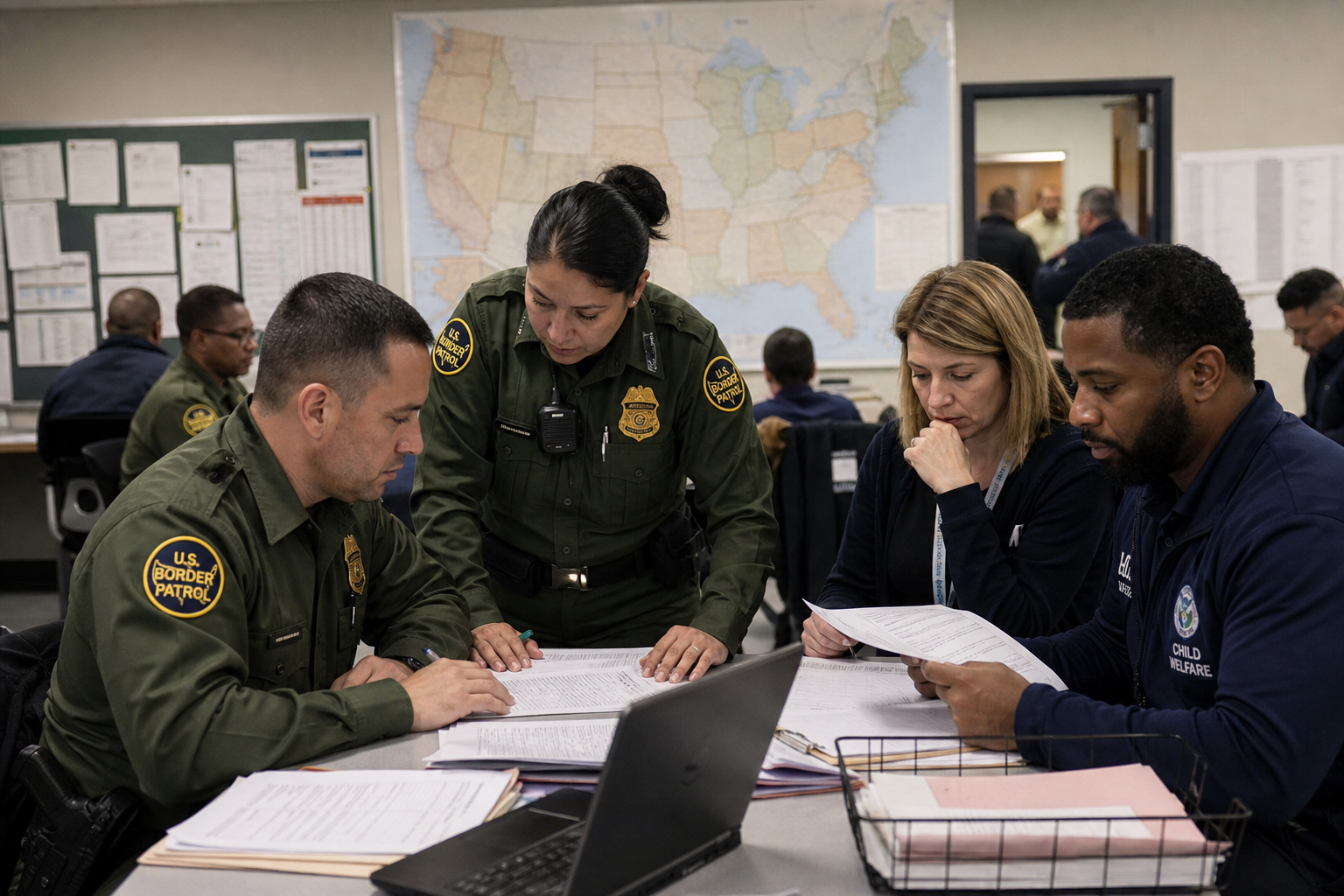
ICE is now trying to locate roughly 450,000 unaccompanied migrant children who entered the United States during the Biden years. Start there.
That number is not a talking point. It is an indictment.
You do not get to a number like 450,000 by accident. You get there through policy. Through incentives. Through an administration that treated mass illegal entry as a processing challenge instead of a deterrence problem. Through slogans about compassion paired with a bureaucracy that could not keep up with the human consequences of its own decisions.
And now the bill arrives.
The failure was not only at the border
Most voters understand the first part of the story. Illegal crossings surged under President Biden after the administration moved quickly to unwind or weaken enforcement tools used by its predecessor. Border communities in Arizona, Texas, and elsewhere saw the result in real time: overwhelmed agents, overloaded facilities, more cartel leverage, and more minors arriving without a parent.
But the second part of the story received less attention for too long.
What happens after a minor crosses the border and is transferred into the federal system? Who sponsors that child? What vetting was done? Was the address verified? Did the child appear for later immigration proceedings? Did anyone check whether the sponsor was legitimate, exploitive, or effectively a stranger? And if contact was lost, who was responsible for finding that child?
Those are not side questions. Those are the questions.
The federal government, primarily through the Department of Health and Human Services and its Office of Refugee Resettlement, places unaccompanied minors with sponsors while immigration proceedings move forward. In theory, that process is supposed to balance speed, safety, and legal accountability. In practice, the surge years exposed major weaknesses in sponsor screening, follow-up contact, and data sharing across agencies.
That is how a border crisis becomes a child safety crisis.
Children are not paperwork
There is a habit in Washington of treating administrative breakdown as if it were a spreadsheet problem. It is not. A child the government cannot locate is not a clerical discrepancy.
It is a human being.
When federal officials lose track of minors, the risks are obvious. Labor trafficking. Sex trafficking. Forced work to repay smuggling debts. Coercion by criminal networks. Quiet exploitation in kitchens, farms, construction sites, and private homes far from the cameras that were present at the border fence.
None of this required imagination. Critics warned from the start that if you advertise entry, limit detention, speed release, and weaken consequences, you create a market. Cartels respond to markets. So do smugglers. Families in desperate conditions respond to incentives too. The route fills up. The pipeline expands. And children become inventory inside a transnational business model.
That was foreseeable. It was foreseen.
Why the 450,000 figure hits so hard
The number 450,000 lands because it tells voters the scale of the disorder. Not 450. Not 4,500. About 450,000.
Say it again. 450,000.
Any administration defending that record will argue that not every child is necessarily missing in the plain-language sense. Some may have moved. Some may have changed contact information. Some may be with relatives who never updated records. That is true as far as it goes.
But that defense only goes so far.
The core fact remains: the federal government accepted these minors into its system and now lacks dependable, current visibility into a staggering number of cases. On an issue this serious, bureaucratic ambiguity is failure. If the government cannot say with confidence where a child is, with whom, and under what conditions, then the process did not work.
And if the process did not work at 10,000, why did the administration keep feeding it at 100,000 and 200,000 and beyond?
The policy incentives were backwards
This is the part many in the press still resist saying plainly. A permissive border posture does not merely respond to migration flows. It shapes them.
When word spreads that minors are likely to be admitted, processed, and released to sponsors inside the United States, more minors come. More accurately, more minors are sent. That distinction matters.
Adults make those decisions. Smuggling organizations market those pathways. Families gamble on them. Children bear the risk.
An enforcement system that fails to impose meaningful consequences on illegal entry will pull more people toward illegal entry. An asylum system clogged for years will invite abuse by people who know delay is functionally its own reward. A sponsorship pipeline under pressure to move children quickly will make more mistakes. This is not complicated. It is cause and effect.
Washington spent years pretending otherwise.
What accountability should look like
Republicans should not settle for generic outrage. They should demand specifics.
A full accounting of how many unaccompanied minors were encountered, released, and placed with sponsors during the Biden administration.
A breakdown of how many could not be reached for follow-up, how many missed court dates, and how many were flagged for trafficking or welfare concerns.
The exact sponsor-vetting standards used during surge periods, including any emergency waivers or shortcuts.
A clear statement of which agencies held responsibility at each stage and where information-sharing failed.
Regular public reporting on ICE efforts to locate minors and refer exploitation cases for prosecution.
Name the agencies. Name the policies. Name the dates. Name the officials who signed the memos.
That is how accountability works.
What comes next
The immediate duty is simple to state and difficult to execute: locate the children, verify their safety, and prosecute anyone who exploited them.
But if that is all Washington does, it will repeat the cycle.
The deeper fix requires restoring deterrence at the border, tightening asylum standards against fraudulent claims, expanding detention capacity where lawful, increasing immigration court throughput, and imposing stricter sponsor verification with real post-release monitoring. It also requires treating cartel smuggling networks as the organized criminal enterprises they are, not as a background condition of migration.
There is also a political lesson here.
Border policy is not abstract. It is not a seminar room dispute over narratives. It produces visible consequences in Yuma, in Tucson, in hotel rooms used as intake sites, in county budgets, in school districts, and now in this brutal question: where are the children?
That question should haunt every official who spent four years blurring the line between enforcement and surrender.
A nation that cannot control entry cannot protect the vulnerable people drawn in by that failure. That is the truth at the center of this story. Not the slogan. The truth.
And the number remains what it is: 450,000.
Mark what federal officials say next. Then ask the follow-up they usually hope you will forget: how did this happen, who allowed it, and what has changed so it does not happen again?
