
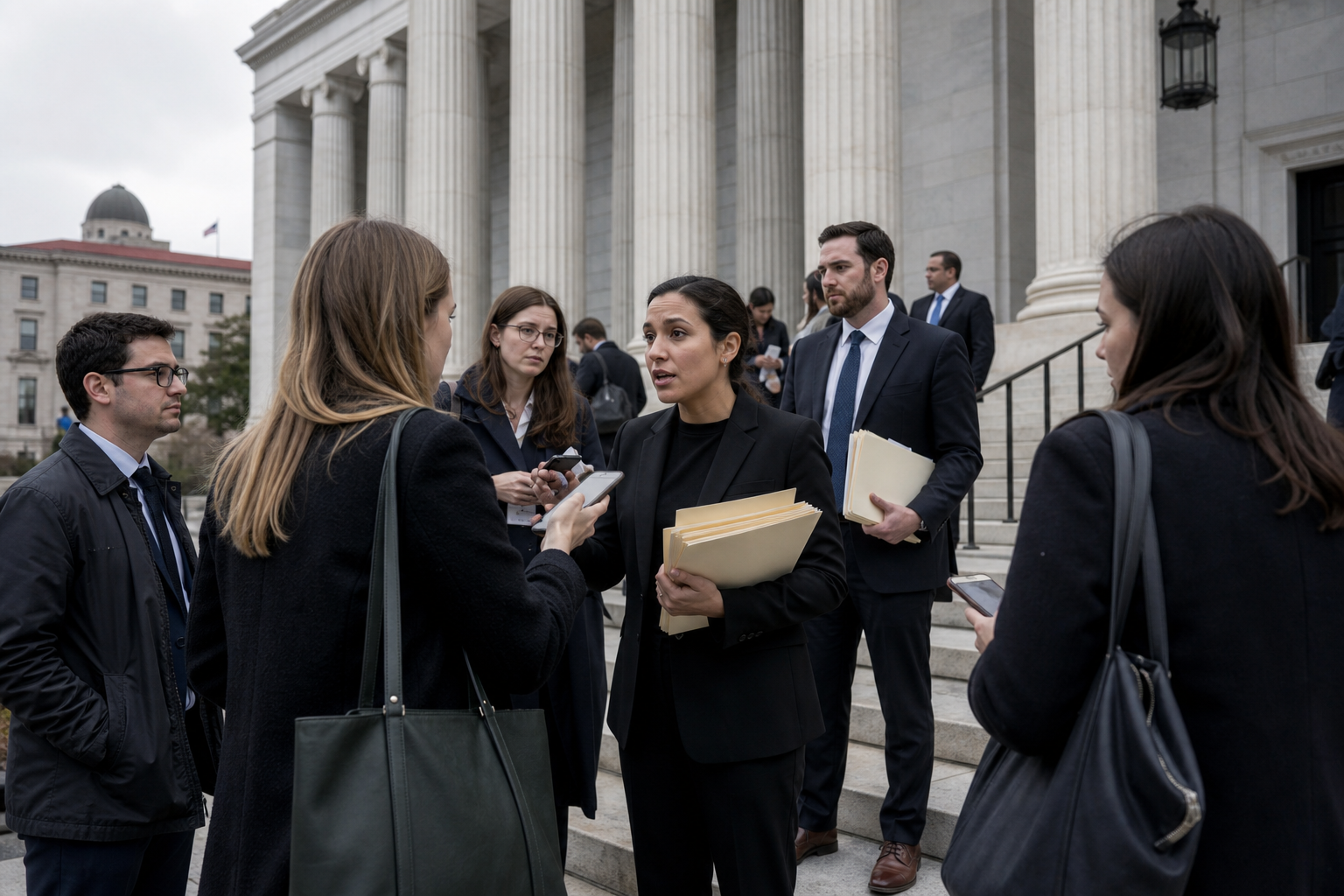
There is nothing new about states suing Washington.
What is new is the scale, the speed, and the obvious strategy. Blue-state attorneys general now operate as a coordinated opposition bench, ready to challenge a Republican administration in court within hours of a policy announcement. If the Trump administration moves on immigration, energy, education, environmental rules, or federal spending conditions, the lawsuit usually lands before the policy does.
That is not an accident. It is the plan.
Litigation as policy warfare
State attorneys general have broad authority to challenge federal action when they argue their states will suffer legal or financial harm. That power is real. Sometimes it is necessary. Federal agencies overreach. Congress writes vague laws and expects regulators to fill in the blanks. Courts exist for a reason.
But the modern multistate lawsuit has become something bigger. It is now a governing tool. One coalition writes the complaint, finds a favorable venue, asks for immediate relief, and tries to freeze a national policy before the administration can fully implement it.
You do not need to guess the objective. The point is delay. Delay matters. Delay can kill a policy as surely as a final loss on the merits. A rule tied up for months or years becomes politically weaker, administratively harder to enforce, and more vulnerable to the next election.
That is especially true in a presidential term, where the calendar is short and every injunction burns time that never comes back.
Why blue states keep doing it
The incentives are obvious.
First, attorneys general in large Democratic states often represent jurisdictions with the money, staff, and institutional capacity to litigate constantly. California, New York, Massachusetts, Illinois, Washington, and others can keep entire teams on federal litigation and join forces with allied nonprofit groups and outside experts.
Second, the media reward the tactic. A lawsuit gives an attorney general a press conference, a clean partisan contrast, and a way to tell the party base that someone is fighting back.
Third, the federal judiciary still allows enough room for nationwide or near-nationwide relief that a single district court order can reshape policy far beyond the plaintiff states. That makes every filing worth the effort.
One judge. One order. Fifty states feel it.
That is a great deal of power flowing through a very narrow pipe.
The legal theories vary. The political goal does not.
The cases usually rest on a familiar menu of claims: that an agency violated the Administrative Procedure Act, failed to give adequate notice, acted arbitrarily, exceeded statutory authority, ignored reliance interests, or imposed costs on states without legal basis.
Some of those claims are strong. Some are not. The point here is not that states should never win. They should, when the law supports them.
The problem is the growing assumption that every disputed federal policy must be converted into emergency litigation. That pushes major questions away from Congress and toward judges. It also encourages administrations to write policy with litigation in mind rather than with democratic durability in mind.
Everybody starts governing for the lawsuit.
That is not healthy constitutional order. It is trench warfare by memo and motion practice.
Immigration remains the central battlefield
No issue shows the pattern more clearly than immigration.
When a Republican administration tightens asylum standards, changes parole policy, leans on detention authority, conditions grants on cooperation, or narrows executive discretion, blue states often argue that the federal move will impose direct costs on their budgets, schools, hospitals, or public services. That creates the standing argument. Then comes the request for immediate judicial intervention.
This matters because immigration policy is one of the clearest areas where the federal government must be able to act with national consistency. Border policy cannot be different in practice because one district judge in one part of the country issued a temporary order while the merits are litigated for a year.
A nation either controls entry or it does not. That is the first duty.
And yet the current pattern often leaves core federal enforcement questions stuck in procedural limbo while states hostile to the administration use court process as an extension of politics.
Energy, climate, and the administrative state
The same model applies to energy and environmental policy. A Trump administration effort to roll back emissions mandates, revise permitting rules, limit agency reach, or expand domestic production will almost certainly meet immediate state litigation.
Again, some of these cases may raise legitimate statutory questions. Agencies do have to follow the law. But there is a broader issue here that conservatives should not miss. Blue-state attorneys general are not merely defending the law as written. They are often defending the accumulated power of the administrative state itself.
They understand something Republicans too often forget: once agencies claim authority, that power rarely shrinks on its own. It has to be taken back. Every lawsuit becomes a defense of agency leverage, procedural choke points, and regulatory delay.
So the fight is not only over one rule. It is over who governs. Congress, the president, or the permanent expert class backed by sympathetic courts.
The venue problem is real
Conservatives have spent years criticizing forum shopping when progressive litigants seek favorable judges. They were right to do it.
The criticism still holds.
When litigants choose jurisdictions because they expect a more ideologically friendly hearing, public trust suffers. That is true whether the plaintiffs are red states or blue states. If national policy can be halted by strategic filing in a chosen courtroom, the judiciary starts to look less like a neutral branch and more like a second legislature with robes.
The answer is not for Republicans to pretend this only became a problem when Democrats got better at the tactic. The answer is structural reform: narrower injunctions, faster appellate review, and a judiciary more reluctant to freeze national policy before the full legal record exists.
What this means for the Trump administration
If Trump returns to office or continues pushing a broad federal agenda, his team will need to build every major policy as if the complaint has already been filed.
That means cleaner rulemaking records. Clearer statutory grounding. Better notice-and-comment procedures where required. More discipline inside agencies. Less improvisation. Fewer loose statements from officials that plaintiffs can use to argue pretext or bad faith.
Politics matters. Process matters too.
Conservatives may not enjoy hearing that. But if you want durable policy, you have to survive judicial review. The Left understands process because process is power. Republicans usually remember that after the injunction arrives.
The larger constitutional question
At bottom, this is a federalism fight with a twist.
Federalism gives states real authority. Good. States should resist unlawful federal action. But federalism was never meant to mean that a bloc of ideologically aligned states could function as a permanent legal veto over every presidential priority they dislike.
That turns the union into a courtroom relay race.
And it leaves voters with a basic problem: if national elections produce policy mandates that are then stalled in district court for most of a presidential term, where exactly does democratic accountability live? Who did you elect? Who actually decides? The cabinet secretary? The attorney general of a hostile state? The judge hearing the emergency motion on a Thursday afternoon?
You can see the problem.
What to watch next
Watch three things.
First, whether courts continue to allow broad injunctions that reach beyond the plaintiff states.
Second, whether Congress takes any serious interest in clarifying agency authority instead of outsourcing every major dispute to litigation.
Third, whether Republican administrations finally learn to write policy that can withstand immediate legal attack.
Blue-state attorneys general are not going to stop. Why would they. The tactic works. It buys time, shapes headlines, energizes donors, and sometimes blocks policy outright.
So this is the field now. Not just ballots. Not just statutes. Motions, injunctions, venue fights, and emergency appeals.
If you care about self-government, you should care about that shift. Because when every election is followed by a courtroom campaign, the public does not just lose speed. It loses clarity about who rules.
Mark that. It will matter more with every filing.
