
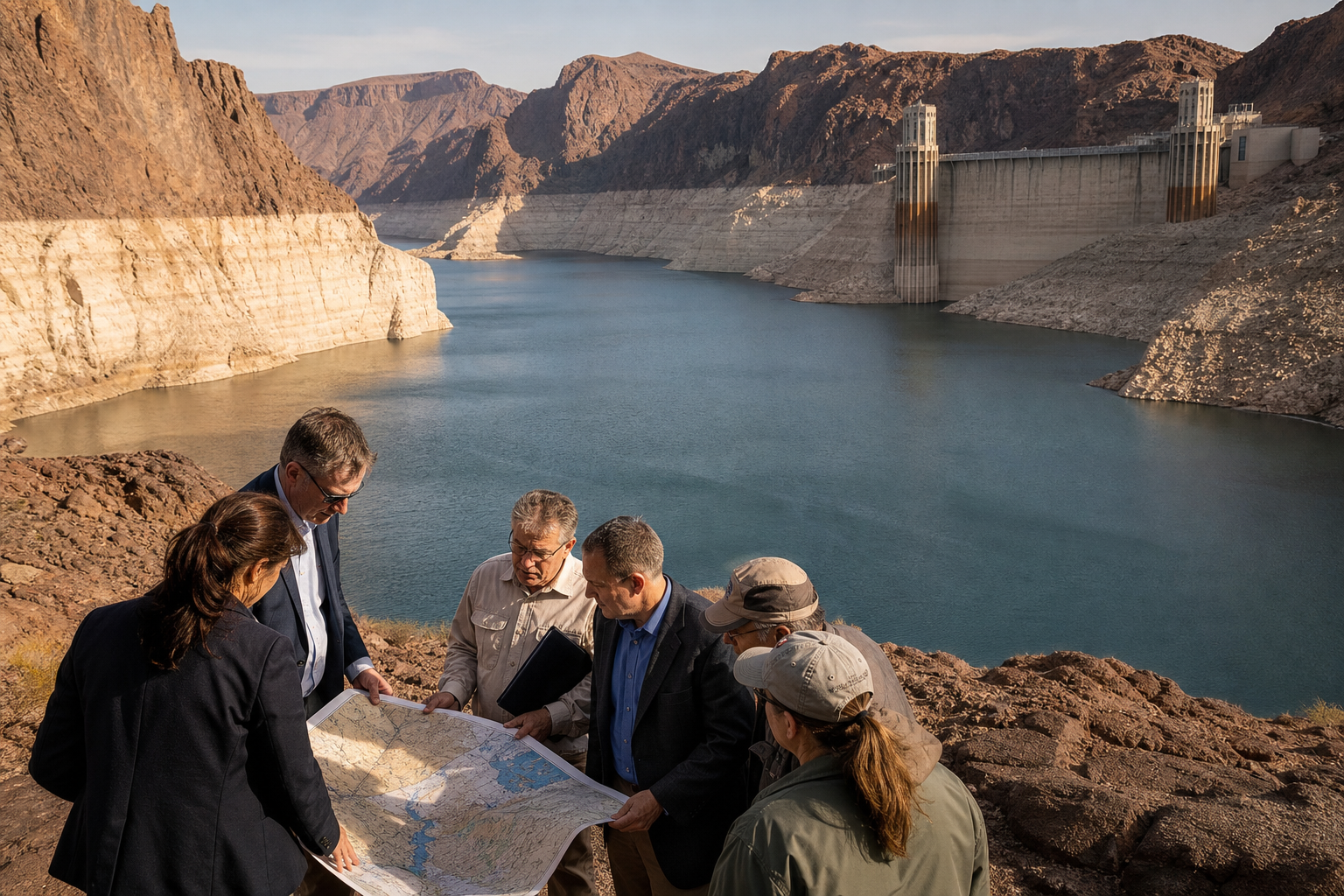
The Colorado River is again doing what Washington hates most. It is forcing the federal government to admit that geography still matters.
The river is overpromised, heavily managed, and under strain from drought, demand, and decades of political delay. That part is not new. What is new is the degree to which federal agencies now sit at the center of decisions that Western states believe were supposed to remain, first and foremost, a matter of negotiated state rights and binding compacts.
This is the real fight. Not just acre-feet. Not just reservoir elevations at Lake Mead and Lake Powell. Control.
The Compact Was Supposed to Be the Framework
The Colorado River system is governed by what lawyers and water managers call the Law of the River: interstate compacts, federal statutes, court rulings, contracts, and agency rules built over more than a century. At the heart of that structure is the 1922 Colorado River Compact, which divided use between the Upper Basin and the Lower Basin.
Then came the Boulder Canyon Project Act, Supreme Court litigation, storage projects, shortage guidelines, and a long list of agreements layered on top of the original deal. The federal government has always had a role because it operates major infrastructure through the Bureau of Reclamation. Nobody serious denies that.
But there is a difference between operating dams and using administrative leverage to rewrite the practical balance among sovereign states.
That difference matters in Arizona, California, Nevada, Colorado, Utah, New Mexico, and Wyoming. It matters to tribes with recognized water rights. It matters to irrigation districts that built local economies around settled expectations. And it matters to every city that has spent years telling residents that conservation alone can outrun math.
Why the Federal Role Is Growing
The federal role is growing for a simple reason. The basin states have struggled to agree on who should absorb the pain.
The Lower Basin states have faced especially hard negotiations because they depend heavily on declining reservoir storage and have different legal priorities. California has senior rights claims tied to agricultural districts and historic use. Arizona has taken painful cuts before and has less room to pretend those cuts are theoretical. Nevada uses far less water overall but still has skin in every operating rule. The Upper Basin states insist they should not be forced to make concessions for shortages driven in part by Lower Basin overuse and structural deficits.
That is the dispute. Everyone supports cooperation until it comes time to assign a number.
When the states fail to reach durable agreement, the Bureau of Reclamation steps in with environmental review, operational alternatives, shortage administration, and pressure campaigns wrapped in the language of emergency management. That is how bureaucratic power expands in the American West. Not with a clean vote in Congress. With a technical memo, a draft alternative, and a deadline tied to a falling reservoir.
Arizona Has More at Stake Than Most
In Arizona, this is not some abstract legal seminar. It reaches from central Arizona subdivisions to Pinal County farmland.
The state takes a large share of its Colorado River supply through the Central Arizona Project. That system is essential to municipal growth and groundwater relief in the interior. When Arizona loses Colorado River water, the pressure does not vanish. It moves. It moves onto groundwater. It moves onto farmers. It moves onto future housing permits. It moves onto electric reliability and local budgets.
You can call that adaptation if you like. Your water bill will call it something else.
Arizona has already endured significant reductions under recent shortage arrangements. State leaders and water agencies have spent years trying to stabilize supplies with conservation deals, funding packages, and negotiated reductions. Some of that work has been necessary. Some of it has simply bought time.
Time is expensive on this river. Every year of delay strengthens the hand of the federal manager who says the states had their chance.
Federal Bureaucracy Is Not Neutral
This is the part many establishment voices glide past.
Federal water managers are not neutral umpires floating above politics. They operate inside a national administration with its own environmental priorities, regional alliances, legal strategy, and appetite for precedent. If Washington gains more discretion over emergency operations today, it will keep that discretion tomorrow. Agencies do not surrender power because a crisis memo expires.
That should concern conservatives even if they support some immediate federal action to prevent collapse at the reservoirs.
Temporary necessity has a way of becoming permanent management. We have seen this in land use, air regulation, species enforcement, and energy permitting. Water is no different. A bureau that can pressure states into revised allocations under emergency conditions will not forget that tool once the paperwork is filed.
And no, the average voter will not get a meaningful say in that process. The notice will be posted. The comment window will open. The experts will speak to one another in acronyms. Then the practical decision will arrive dressed up as inevitability.
There Is a Better Conservative Position
The right answer is not to deny hydrology. The river is stressed. The numbers are real. Conservation, infrastructure, reuse, and more disciplined growth planning all matter.
The right answer is to insist that durable changes come from accountable agreements among the states, with Congress involved where statute requires, rather than from federal agencies governing by managed crisis.
That means a few things.
First, protect the compact framework. Interstate compacts exist so states can govern shared resources without surrendering every dispute to the executive branch.
Second, insist on transparency. Operational proposals, shortage models, and conservation assumptions should be public, understandable, and tied to clear legal authority.
Third, reject the fiction that one region can permanently subsidize another. Every basin state will have to absorb real limits. The question is whether those limits are negotiated honestly or imposed administratively.
Fourth, stop using one-time federal money as a substitute for structural reform. Subsidy can ease a transition. It cannot repeal shortage.
What Comes Next
The current era of Colorado River negotiations is moving toward long-term operating rules that will shape the basin well beyond the next election cycle. Those rules will affect storage, deliveries, conservation obligations, hydropower stability, and the legal balance between the states and Washington.
That is why this story matters now.
If the states present a united, credible framework, they keep more authority where it belongs. If they fail, federal agencies will fill the vacuum. They always do.
In the West, water is not a side issue. Water is land use. Water is food production. Water is housing. Water is power. Water is local self-government.
And once Washington converts a management crisis into a precedent, you do not get that authority back with a sternly worded press release.
Mark the next round of basin negotiations closely. Watch what the Bureau of Reclamation claims it must do. Then ask the simple question that cuts through the jargon: is this a temporary response to shortage, or another permanent transfer of power from the states to the federal bureaucracy?
On the Colorado River, that is the whole argument.
