
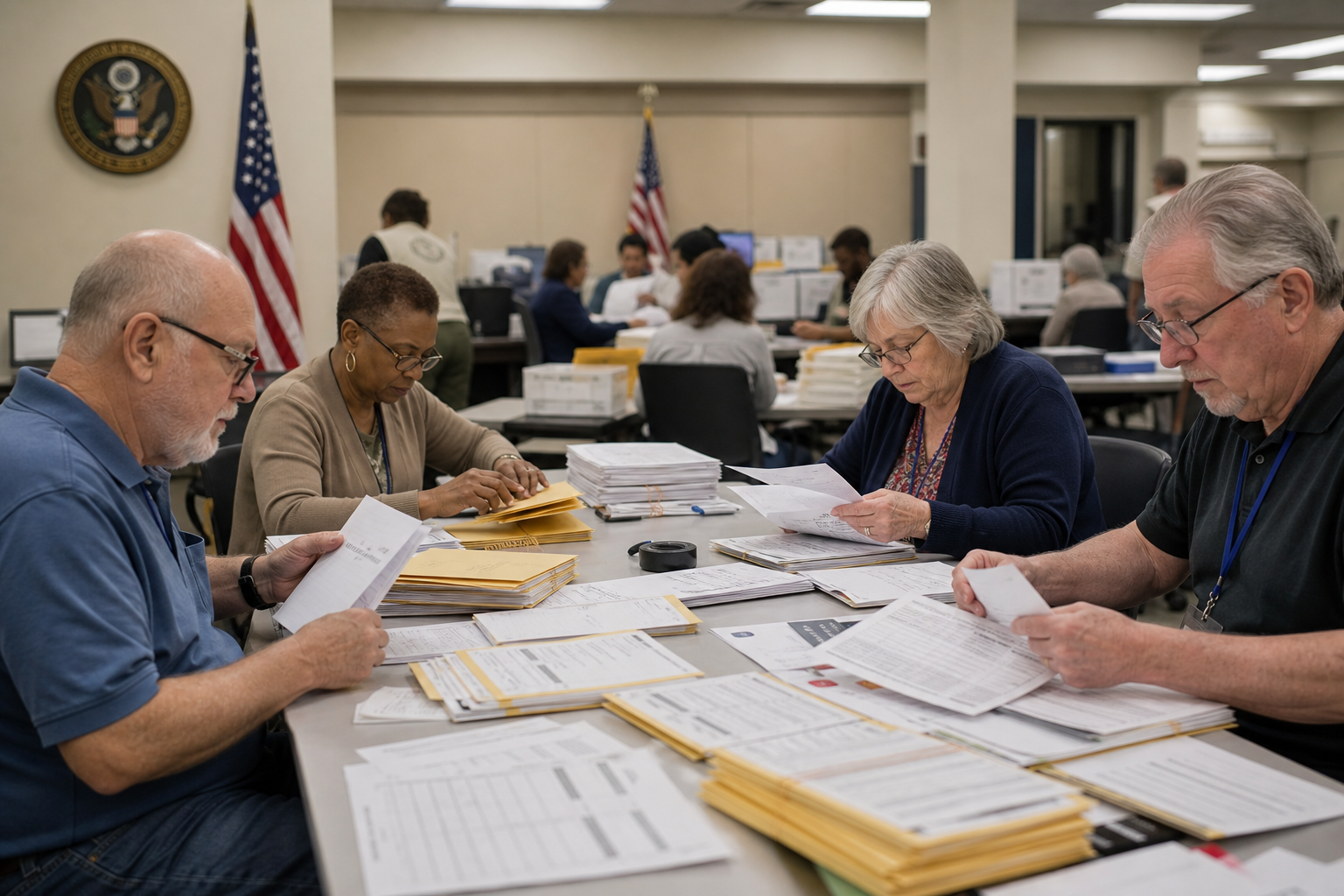
The Ohio secretary of state says his office has referred evidence of suspected voter fraud to authorities in eight states. That is the headline. The more important fact is what it tells you about the modern election problem in America.
It is not only a question of ballot counting on one night in one county. It is a records problem. A chain-of-custody problem. A data-sharing problem. And, above all, a trust problem.
When one state says it found evidence that may involve registrations or ballots crossing state lines, the case immediately becomes larger than Ohio. It becomes a test of whether election integrity is treated as a national administrative duty or just a campaign-season slogan.
What a referral means, and what it does not
A referral is not a conviction. It is not proof that every flagged case will hold up in court. Conservatives should be disciplined enough to say that plainly.
But a referral is also not nothing. A state official does not send material to other states, prosecutors, or investigators as a hobby. A referral means election records, voting history, registration data, or identity information raised enough concern that the matter needed formal review outside the initial office.
That matters.
Too much of the election debate swings between two lazy poles. One side says every irregularity proves the whole system is corrupt. The other side says any concern at all is conspiracy talk. Neither position helps you govern a republic.
The serious position is harder and less glamorous. Investigate the specific case. Identify the procedure that failed. Fix it. Then publish enough information that the public can see the fix.
Why cross-state voting issues are uniquely serious
If a person is registered in more than one state, that alone does not prove fraud. Americans move. Records lag. Databases update at different speeds. Some local offices are competent. Some are not. That is real life.
But if a person cast ballots in more than one jurisdiction for the same federal election, or if records suggest that possibility strongly enough to trigger a referral, the issue is serious for one reason: it strikes at the most basic rule in self-government. One eligible citizen gets one vote in the election that applies to him.
One vote. Not two. Not one in the old state and one in the new state. Not one by mail and one in person if the systems fail to reconcile in time.
If states cannot reliably detect and deter that kind of conduct, they will keep losing public confidence even when the total number of proven cases is small. That point often frustrates election administrators, but it is still true.
An election system does not have to be massively corrupt to become politically unstable. It only has to be opaque enough that normal citizens cannot tell whether safeguards are real.
The policy failure beneath the headline
The Ohio referrals point to a deeper institutional weakness: America still runs elections through a patchwork of county offices, state databases, federal rules, and uneven interstate cooperation. You can call that decentralized. Sometimes that is healthy. Federalism has virtues.
But decentralization without clean reconciliation standards creates avoidable vulnerabilities.
If one state removes a voter slowly, another adds him quickly, and a third agency updates citizenship, death, or address records on a different timetable, the result is predictable. The system generates opportunities for error. And opportunities for bad actors.
This is where conservatives should be specific.
States should conduct regular voter list maintenance required by law, not perform it only after litigation or media pressure.
States should verify interstate moves promptly through reliable records and direct notice procedures.
States should reconcile absentee ballots, in-person voting history, and provisional ballots quickly enough to stop duplicate voting before certification.
States should refer suspicious cases for prosecution and then report outcomes publicly.
That last point is neglected. A referral with no follow-up leaves the public where it started. Voters hear that a case was flagged, then hear nothing else. Was it prosecuted. Was it dismissed. Was it clerical error. Was it deliberate fraud. The public deserves an answer.
Transparency is the missing piece
I have said this before about election administration in Arizona, and it applies here too. A system should not demand trust when it can provide verification.
If suspected misconduct was referred to eight states, voters should eventually be told, with lawful privacy protections, what category of conduct was involved and what each jurisdiction found. Not rumors. Not selective leaks. Findings.
Election officials tend to resist this kind of disclosure because they fear public misunderstanding. That is backward. Public misunderstanding grows fastest in silence.
Post the process. Explain the match criteria. State the number of referrals. State the disposition when complete. If a case was false positive, say so. If a crime occurred, say so. If a county failed to maintain its rolls, say so.
You do not rebuild confidence with scolding. You rebuild it with receipts.
This is not an argument against voting access
The left often answers election-integrity concerns by pretending every safeguard is a plot to suppress lawful voters. That is unserious.
Requiring accurate registration records, clean list maintenance, identity verification, and interstate coordination does not prevent legal voting. It protects legal voting.
In fact, the weakest election systems often burden legitimate voters the most. When records are sloppy, lawful voters get pushed into provisional ballots, delayed check-ins, or post-election disputes. Clean administration is not the enemy of access. It is the condition for credible access.
Republicans should say that without apology.
What other states should do now
Every state named in an Ohio referral should treat the matter as an audit trigger, not just a criminal file. Was the issue caught because the system worked, or because one office happened to notice something unusual? There is a difference.
If the detection method depended on luck, then the lesson is not reassuring.
State election directors and secretaries of state should use this moment to review three things immediately.
How quickly voter history is updated after each election.
How often interstate data is compared for duplicate registrations and potential duplicate voting.
Whether prosecutors actually pursue election-fraud referrals or quietly let them die.
That third point matters more than many politicians admit. Laws that are never enforced become press releases. Voters know the difference.
The conservative test
There is also a message here for Republicans. If you campaign on election integrity, then govern on election integrity. Fund the database upgrades. Require regular public reporting. Standardize referral procedures. Shorten the lag time between a flagged case and a public disposition. And stop treating transparency as optional when your party holds office.
Republicans who demand scrutiny only when they lose are not serious. Democrats who call every integrity measure an attack on democracy are not serious either.
The standard should be the same in every state, every cycle, every race. Clean rolls. Verifiable ballots. Prompt investigations. Public answers.
Ohio's referrals may end with convictions, dismissals, or a mix of both. We do not know yet. What we do know is that one state saw enough to send material across state lines. That alone should force a broader review.
This is how election confidence is either repaired or squandered. Not with speeches. With procedures. With records. With visible enforcement.
Mark the next step. Watch whether the eight states involved tell the public what they found. If they do, confidence can begin to recover. If they do not, you will be asked once again to trust a process that declines to show its work.
