
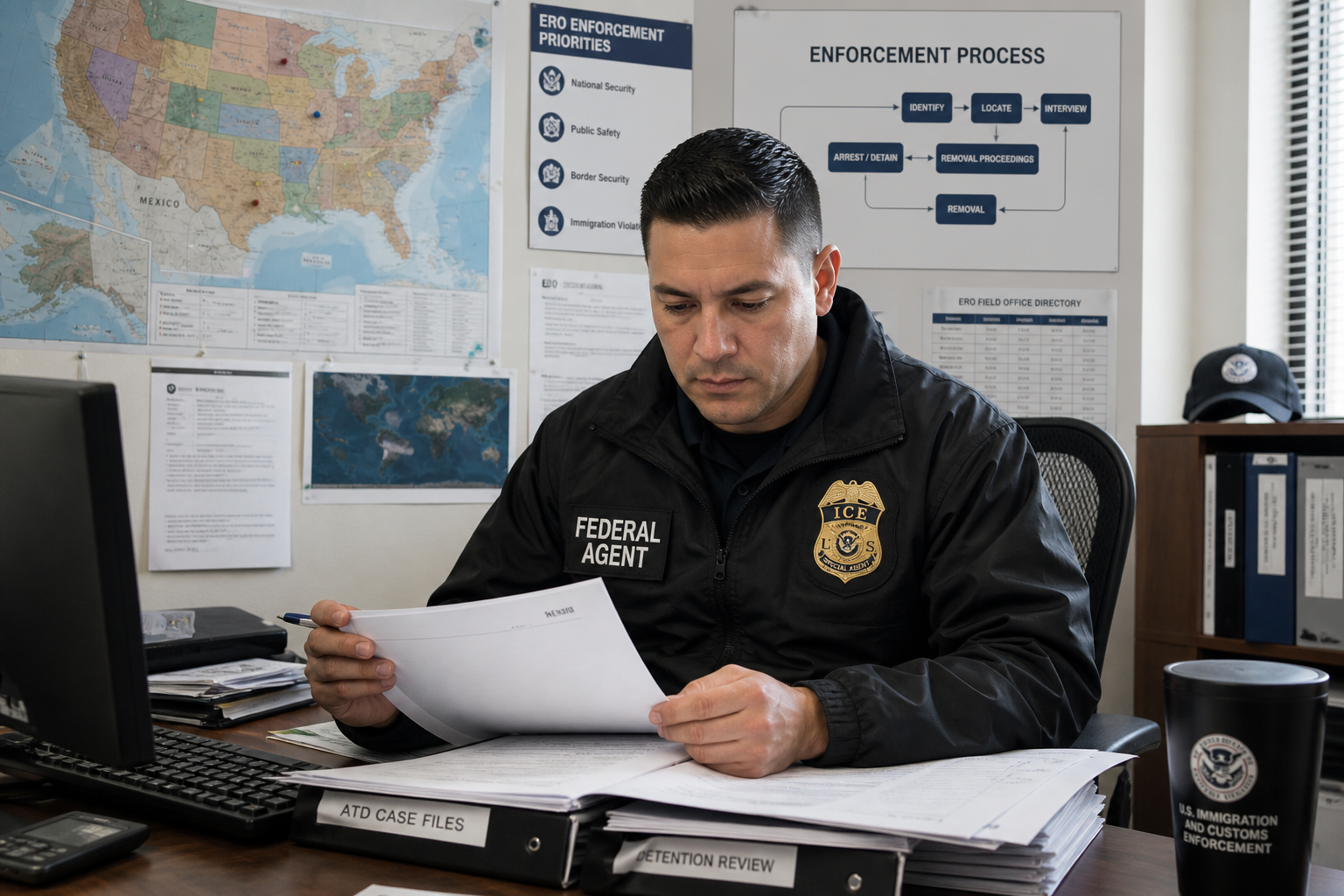
Accounting for Half a Million Children: The Scope of the Problem
Immigration and Customs Enforcement has committed resources to tracking down roughly 450,000 unaccompanied migrant children who were released to sponsors during the Biden administration. The number alone should stop you in place. Four hundred fifty thousand. Not thousands. Not tens of thousands. Nearly half a million.
These children entered U.S. custody. They were then transferred to sponsors—adults who agreed to supervise them while their immigration cases proceeded. The federal government's responsibility did not end at the handoff. It continued. It was supposed to continue. Instead, for hundreds of thousands of these cases, the government lost systematic track of whether the children were safe, where they were living, or whether the adults claiming to be guardians had been properly vetted.
This is not a procedural inconvenience. This is the federal government acknowledging it cannot account for the whereabouts and condition of half a million minors in its custody.
The Vetting Gap
The Trafficking Victims Protection Act requires that sponsors undergo background checks before minors are released to their care. The law exists because the alternative—placing vulnerable children with adults whose backgrounds have not been examined—creates obvious risks. Criminal history. Gang involvement. Exploitation. Forced labor. The statute was written because these outcomes happen without protective procedure.
During the period in question, the volume of arrivals overwhelmed processing capacity. That is a fact. But facts do not excuse abandoning statutory requirements. When your system cannot manage the workload while maintaining legal compliance, the correct answer is to reduce intake or to expand your capacity while maintaining standards. The answer that was apparently chosen was to maintain intake while quietly relaxing standards, then discovering later that hundreds of thousands of cases lacked proper documentation.
You are the taxpayer funding this system. You should want to know whether the adults caring for these children have been checked. The government should want to know. If it did not, that is a separate and more serious problem than mere disorganization.
Tracking After Release: The Accountability Vacuum
Release to a sponsor is not the end of supervision. In theory. A case manager is supposed to conduct home visits, monitor the child's enrollment in school, and verify that the child appears safe. The law requires it. The regulations require it. In practice, across hundreds of thousands of cases, these follow-up steps either did not occur or were not documented in any retrievable way.
Now ICE is announcing an operation to find these children, verify they are alive and accounted for, and confirm their current circumstances. Think about what that announcement means. It means the government does not currently know where they are. It means the government does not currently know whether they are in school, whether they are being exploited, whether they remain with the sponsor who received them, or whether they have vanished into the kind of informal economy that traffickers depend on.
For half a million children. The scale is not metaphorical.
What the Operation Reveals About Government Capacity
When a government agency discovers it has lost track of 450,000 people—particularly minors—in its custody, the response should be forensic. Who made the decision to reduce vetting? When? What was the written justification? Who signed off? What was the chain of approval? You will not receive those answers in any timely form, if at all. Agencies do not release documents showing they violated statute because someone did not want to be blamed for a processing bottleneck.
But here is what you already know: Someone made a choice. Someone decided that the volume of arrivals could be processed only if the vetting steps were de-prioritized or eliminated. That someone reported to someone else. That bureaucratic decision—made in an office with fluorescent lights and a coffee machine—resulted in half a million children being released to unvetted adults.
And now that the gap has become visible to oversight bodies and to the press, the agency is running a tracking operation to find them. This is the government admitting what happened, in the most reluctant possible way: by announcing a remedial operation that would be unnecessary if it had followed its own rules from the beginning.
The Border as a System Problem
This did not happen because of cruelty. It happened because of capacity. The northern border received more than 5 million encounters during the Biden administration. The system designed to process child migrants was built for a fraction of that number. Rather than slow down processing or implement restrictions on entry that might have reduced the flow, the administration chose to accelerate release to sponsors with reduced vetting.
That was a policy choice. It was made by people. It was documented. And when the consequences of that choice became visible—when the government realized it could not locate half a million children it had released into the country—the same bureaucracy responded by announcing it would conduct a tracking operation.
You cannot unspool half a million cases. You can conduct spot checks. You can audit a sample. You can announce intentions. But the children are already in their current situations, with their current guardians or in their current circumstances, whatever those are. The damage is not undone by an operation announced after the fact.
What Happens Next
Follow this operation's progress. Not its rhetoric. Not its announcements. Its actual results. How many of the 450,000 children will actually be located? Of those located, how many will be verified to be safe? How many will be found to be in situations that suggest exploitation or trafficking? How many case files will be found to be incomplete?
Those numbers matter more than the operation's name or its stated scope. They will tell you what actually happened and what the true scale of the problem is. Mark your calendar for six months from now. If you do not see a detailed breakdown of those metrics, assume the operation encountered more cases that cannot be resolved than cases it can account for.
That is what you should want to know from the agency that lost track of 450,000 children in the first place.
