
The Question on the Ballot
Arizona voters are being asked to decide whether the state should require photo identification at every polling place, every election, with no exceptions. That is the substance of Proposition 144. Not a modest tightening. Not a pilot program. A categorical requirement that applies to primary elections, general elections, special elections, and ballot measures.
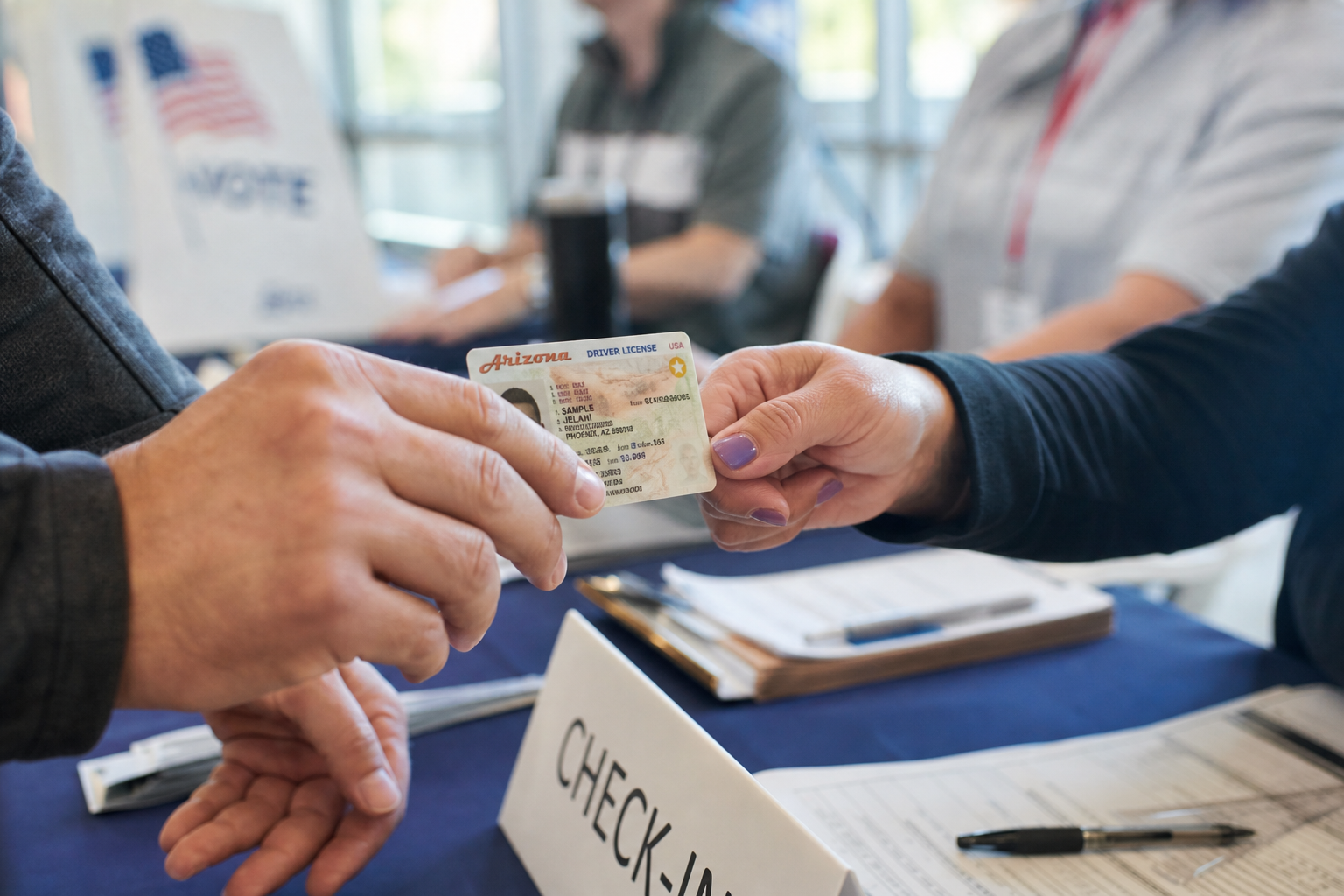
The state currently accepts a mix of IDs. A driver's license works. A tribal ID works. A utility bill with a current address works. Military ID, passport, college ID if it has an address — all of these clear you to vote. Proposition 144 would narrow that list to government-issued photo identification only.
This is not an abstract debate between two equally reasonable positions. It is a concrete disagreement about what election administration should look like, and it matters for how you vote.
Why This Matters Now
Arizona has been a flashpoint in the national election integrity argument for four years. The 2020 presidential election generated questions about mail ballot handling, signature verification, and chain of custody procedures. Those questions led to audits, to legislative inquiries, and to a fundamental erosion of public confidence in Maricopa County election procedures. Whether that erosion was justified or not, it happened, and it persists.
Proposition 144 is framed as a response to that erosion. Its proponents argue that requiring photo ID at the polls creates a clearer verification standard. No ambiguity about whether a signature matches. No questions about whether an affidavit satisfies the requirement. Either you have a photo ID, or you do not.
That argument has appeal. Clarity has value in election administration. A standard that does not require subjective judgment by poll workers reduces opportunities for inconsistency.
But there is another side to this, and it is worth understanding before you vote.
The Implementation Question
Arizona votes early. More than 80 percent of ballots cast in recent general elections were mailed to voters before Election Day. Those voters never set foot in a polling place. They fill out their ballot at home, seal it in an envelope, and mail it back or drop it in a ballot box.
Proposition 144 only applies to in-person voting. It does not change mail ballot procedures. Your mail ballot will go through the same signature verification process it always has — a poll worker compares your signature on the envelope to your signature on file. If they match well enough, your ballot counts. If they do not, election officials attempt to contact you and give you a chance to fix it.
This creates a two-tiered system. If you vote by mail, your identity is verified by signature matching. If you vote at a polling place, your identity is verified by photo ID. Why the difference? Because mail ballots have no good way to check an ID. You are not there to show one.
The practical effect is this: Proposition 144 tightens the standard for one small slice of voters — those who choose to vote in person on Election Day — while leaving the larger electorate under the current system.
The Partisan Calculus
Republicans support Proposition 144. Democrats oppose it. That alignment tells you something important: each side believes the change will affect their voters differently.
Republicans argue that photo ID requirements prevent fraud. The evidence on voter impersonation fraud is thin. Multiple studies have found it extraordinarily rare. But that does not mean it has never happened, and it does not mean the risk is literally zero.
Democrats argue that photo ID requirements suppress turnout, particularly among older voters, voters without driver's licenses, and voters experiencing homelessness. The evidence on this is also mixed. Some studies find measurable turnout effects. Others find negligible ones.
Arizona is not starting from zero on this question. The state has accepted photo ID as one valid form of identification since at least 1996. Voters in Arizona already know photo ID is an option. The change Proposition 144 makes is to eliminate all other options.
The Transparency Angle
Here is what tends to get buried in these debates: election administration in Arizona is already public in many ways. Poll workers are trained and certified. Their procedures are written down. The voter rolls are maintained according to state law. Ballot chain of custody is documented. None of this is secret.
The question Proposition 144 poses is not whether elections should be transparent. They already are. The question is whether a single verification standard — photo ID — should replace a multiple-option system that includes less rigorous alternatives.
Supporters of the measure say a single standard is clearer. Opponents say it is unnecessarily restrictive. Both claims have merit. The merit depends on which you weight more heavily: administrative clarity or voter access.
What You Should Know Before Voting
Proposition 144 is scheduled for the 2024 election. If it passes, it becomes state law. Arizona counties would be required to implement it for the 2024 general election and all elections thereafter.
This is not a decision that can be reversed easily. You are voting on whether to bind future Arizona legislatures and future Arizona county officials to a specific election procedure. Ask yourself whether you trust the people who will be running elections under that procedure. Ask yourself whether a photo ID requirement solves a problem you think actually exists. Ask yourself whether you are comfortable with a system where 80 percent of voters use one verification method and 20 percent use another.
Then go vote. It is the only check on this that actually works.
