
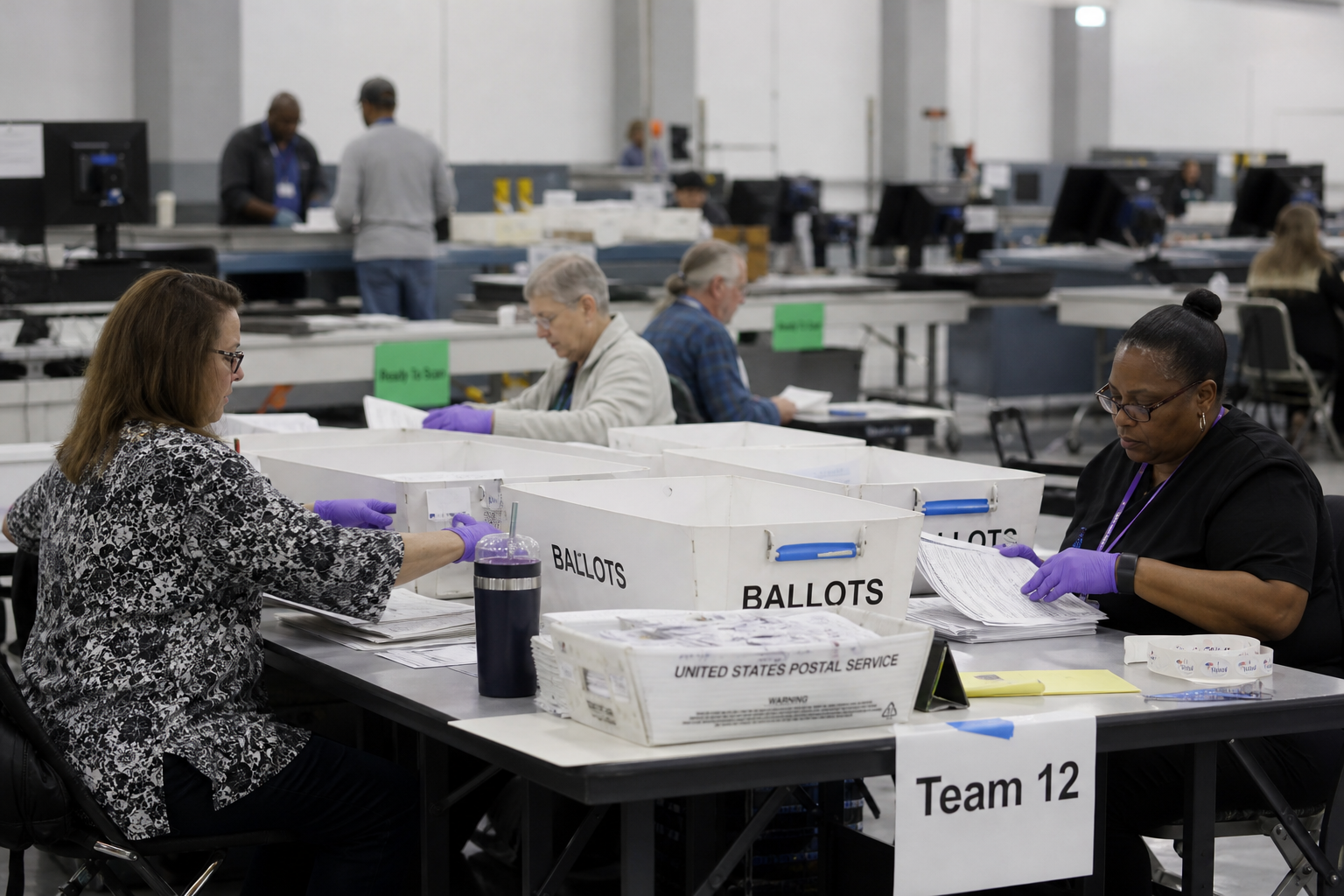
The Architecture of Trust in Ballot Counting
When a voter drops a ballot into a tabulator in Maricopa County, that ballot enters a process governed by statute, procedure, and, crucially, by practices that either invite public scrutiny or discourage it. The question before Arizona voters is straightforward: Can you watch the system work, or must you simply trust that it does?
Maricopa County processes ballots through vote centers on Election Day and through mail ballot facilities in the weeks before. Both operations follow Arizona Administrative Code Chapter 12-7 and county policy directives. Both operations also reveal a pattern: procedures exist in writing, but the actual implementation of those procedures often remains invisible to the public.
Take the reconciliation process. After the machines count ballots at vote centers on Election Day, county officials balance three numbers: ballots cast, ballots counted, and ballots remaining. This reconciliation is supposed to happen on Election Night. It is supposed to happen in public. The results are supposed to be posted by precinct so that a losing campaign—or a concerned voter—can check the math on November 8th or whenever the election occurs, not in March when the case has been decided and the interest has evaporated.
What Voters Cannot See
Here is what currently happens in practice: Maricopa County publishes aggregate reconciliation numbers days after the election. Precinct-level detail follows weeks later, often after media inquiries. Chain-of-custody documentation for ballots moved between locations exists in county files but is not systematically posted for public review. The signature verification process—the only human decision point in mail ballot processing—produces no public record of how many signatures were flagged, by whom, and under what standard.
None of this violates Arizona law. All of it falls within county discretion. And all of it creates the conditions for legitimate questions about whether the system is designed to be verified or merely to be believed.
I have stood in the tabulation center in Phoenix on election night. I have watched the process. The work is deliberate. The staff appears competent. But competence and transparency are not the same thing. A system operated by trustworthy people can still be structured in a way that makes verification impossible for voters who did not win.
The Conservative Case for Procedural Openness
This is not an argument that fraud occurred in Maricopa County or Arizona. It is an argument about what a constitutional republic requires: not faith in government, but the capacity to check it.
Article II, Section 1 of the Arizona Constitution vests election authority in the legislature. The legislature has delegated ballot counting procedures to the county. But delegation does not eliminate responsibility. A county that makes it harder for voters to verify results than to cast them has inverted the relationship between the government and the governed.
Consider what transparency costs. Post reconciliation numbers by precinct on Election Night. Publish chain-of-custody logs for every ballot batch moved. Document the standard applied to signature verification and release aggregate counts weekly. Post video of mail ballot opening procedures. None of these steps changes how ballots are counted. All of them allow a losing side to confirm its own loss.
Why resist these steps? The arguments heard in county meetings and legislative halls usually follow three lines: it is expensive; it is time-consuming; it creates security risks by revealing procedural details to bad actors.
The expense argument does not survive scrutiny. Maricopa County's elections budget is approximately $80 million annually. Adding staff to produce public reconciliation reports by precinct and by vote center would cost in the low hundreds of thousands. That is audit work, not transformation.
The time argument is stronger but reveals a choice. Yes, posting results takes staff hours. But those hours compete with other work only if the county decides they do. Arizona holds elections in November. There is no deadline pressure in December, January, or February. The time constraint is self-imposed.
The security argument is the one that deserves a direct answer: no, publishing ballot batch numbers and chain-of-custody transfers reveals nothing to a bad actor that does not already appear in public records under Arizona Public Records Law. What it does is make those records accessible and organized rather than scattered and obscure.
Where Maricopa Has Moved Forward
To be clear: Maricopa County has made improvements over the past four years. Vote center tabulator tapes are now preserved and available for audit. Mail ballot envelope images are retained. The county has increased the frequency of election audits and expanded their scope. In 2022, the county published precinct-level results the day after the election, a step in the right direction.
These steps matter. They show that change is possible when scrutiny increases. They also show what remains possible: more consistent public reporting, more regular posting of reconciliation data, and more systematic transparency around signature verification.
The Real Question Before You
Your responsibility as a voter does not end on Election Day. It includes knowing whether the votes you cast are counted as cast. Maricopa County can make that verification possible or continue requiring you to trust that it happened. The county will make that choice based on whether you, as a precinct committeeman, as a candidate, as a parent, as a concerned voter, demand it.
The next county board of supervisors meeting is the place to ask. The next legislative session is the place to push for statutory language requiring precinct-level reconciliation posting. The next county Republican Committee meeting is the place to establish that this is a conservative priority, not a partisan talking point that changes with election outcomes.
Mark your calendar. Ask the specific questions. Demand the specific documents. The system will become as transparent as you require it to be.
