
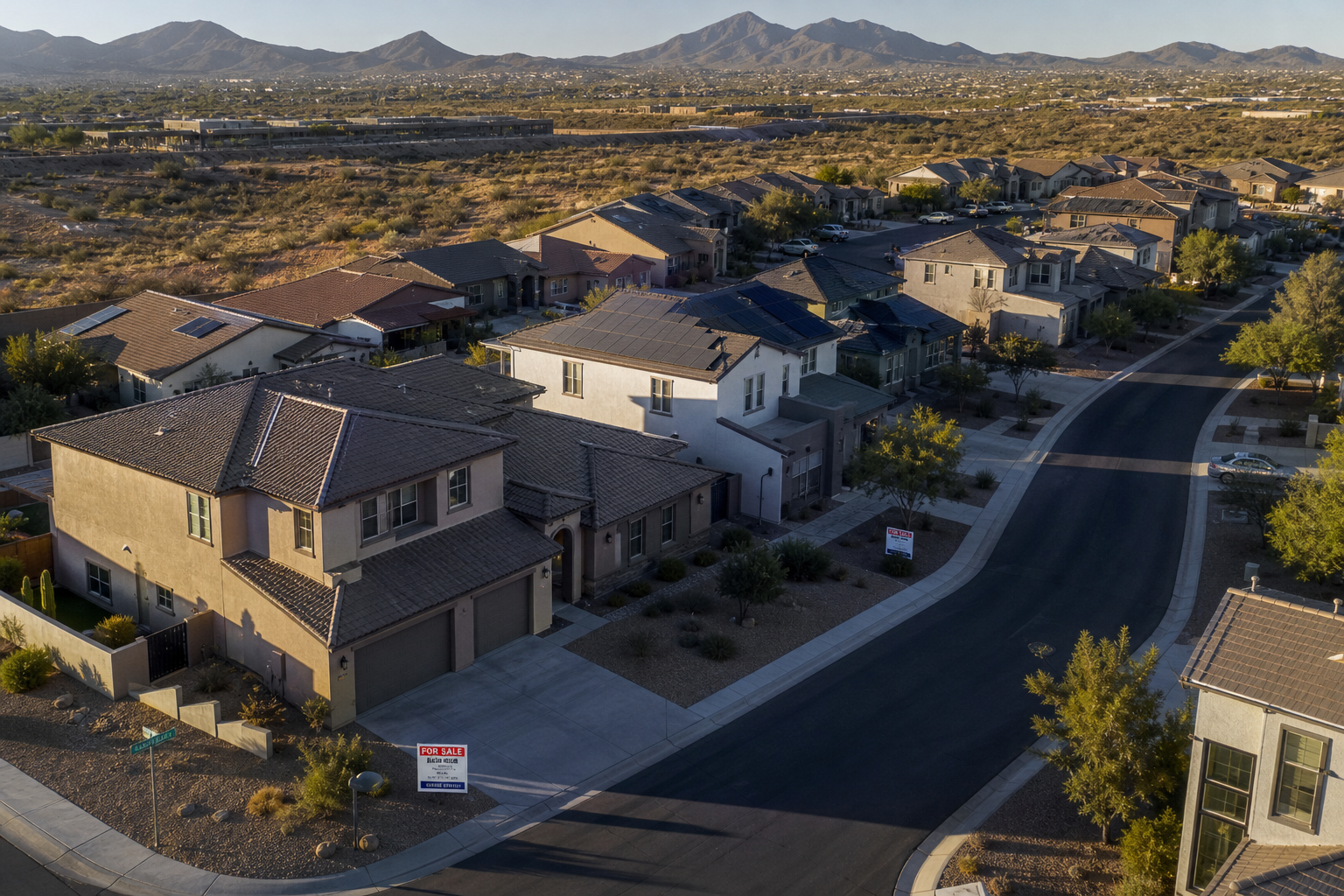
Arizona's Housing Market Reveals What Washington Refuses to Admit
The Arizona housing market stopped pretending last quarter. Median home prices in the Phoenix metropolitan area declined from their 2022 peak. Mortgage rates stayed elevated—hovering between 6.5 and 7 percent—making the monthly payment on a median-priced home roughly $400 higher than it was three years ago. Inventory ticked upward as sellers recognized the buyer side of the market had fundamentally changed.
This is not a local story. It is a national story that Arizona is simply telling first, because Arizona built too much and borrowed too much when the money was cheap and the appraisals were loose.
What the Numbers Actually Show
The Federal Reserve has raised its benchmark interest rate from near zero in March 2021 to over 5 percent by the end of 2023. That decision was the correct response to the inflation the government spent into existence. But decisions made in Washington always arrive in Phoenix as consequences.
Higher rates mean higher borrowing costs for everyone. For a homebuyer with $50,000 down, the difference between a 3 percent mortgage and a 7 percent mortgage is not academic. It is the difference between affording a $350,000 home and a $250,000 home. When the rate goes up, the buying power goes down. When buying power goes down, prices have to follow.
Arizona's market is experiencing that compression now. Prices are down year-over-year in most Maricopa County neighborhoods. The construction pipeline that produced 40,000 housing units annually at the market's peak is contracting. Home builders are offering buyer concessions—covering closing costs, buying down rates, extending possession timelines—because they cannot move inventory at the prices they projected.
When a builder cannot move inventory, he stops breaking ground on new developments. When he stops breaking ground, the subcontractors who frame and wire and plumb those homes lose work. Construction employment, which drove Arizona's job growth for five consecutive years, turns negative.
The Demand Side Collapse Nobody Talks About
Arizona's population growth since 2015 was real. Families left California. Young professionals came for jobs and lower taxes. Retirees came for the climate. Phoenix grew. But much of that growth was financed with adjustable-rate mortgages, cash-out refinances, and construction loans taken at 2020s rates.
When rates normalized, the arbitrage collapsed. Homeowners with payments locked in at 2.75 percent are not selling—they are staying put. Prospective buyers who could afford a home at 3 percent cannot afford that same home at 7 percent. The buyer pool shrinks. The market stalls.
This is what happens in a state where housing supply responded to easy credit instead of actual demand. When the credit engine stops, the supply sits. Empty driveways. Unsold models in developments that promised the next generation of Arizona prosperity.
What This Means for Arizona's Budget
State government is about to discover what voters in builder counties discovered six months ago. Arizona's tax revenue, particularly property tax and transaction tax, depends on a moving housing market. When the market stalls, so does revenue growth.
The 2024-2025 budget was premised on continued home sales at elevated prices. Agents were going to pocket commissions. Title companies were going to record transactions. Governments and schools were going to cash those transaction surcharges. The assumption was built into the projection.
That assumption is now backward. Fewer closings mean fewer recording fees. Fewer transactions mean fewer agent commissions moving through the tax base. A home that sold for $450,000 in 2022 that now sells for $380,000 produces 16 percent less primary property tax revenue.
The state legislature will have to choose between restraint and raiding reserves. Neither is politically popular. But one is mathematically necessary.
Employment and Consumer Confidence Follow Housing
Arizona added roughly 120,000 jobs in 2022 and 2023. Much of that growth was construction-related or ancillary to construction—suppliers, services, financial positions tied to originations and sales. When housing stalls, that job growth stalls first, then reverses.
A construction worker who loses 20 hours of work per week stops buying discretionary goods. His wife recognizes the income volatility and pauses a planned business expansion. Their neighbors see the slowdown and hire more cautiously. The confidence effect bleeds across sectors.
This is not inevitable recession. It is the leading indicator that should be taken seriously by anyone making hiring or spending decisions in 2024.
The Conservative Policy Question
The immediate conservative response is to blame inflation and the Federal Reserve, and that blame is justified. But the deeper question is why Arizona's economy became so dependent on one sector—home building financed by floating-rate money—in the first place.
The answer is that easy credit and asset bubbles are bipartisan creations. Both parties talk fiscal responsibility while voting for spending. Both parties talk inflation while endorsing monetary accommodation. The consequences of those choices always arrive at the local level first, and they always arrive in housing.
Arizona has a choice: address the structural dependence on cyclical industries and move toward a more diverse economic base, or continue to treat housing booms and busts as normal and plan accordingly. The first requires real work. The second requires accepting that boom-bust cycles will continue to destabilize state budgets, employment, and planning.
The market is already choosing. Watch what it does next.
