
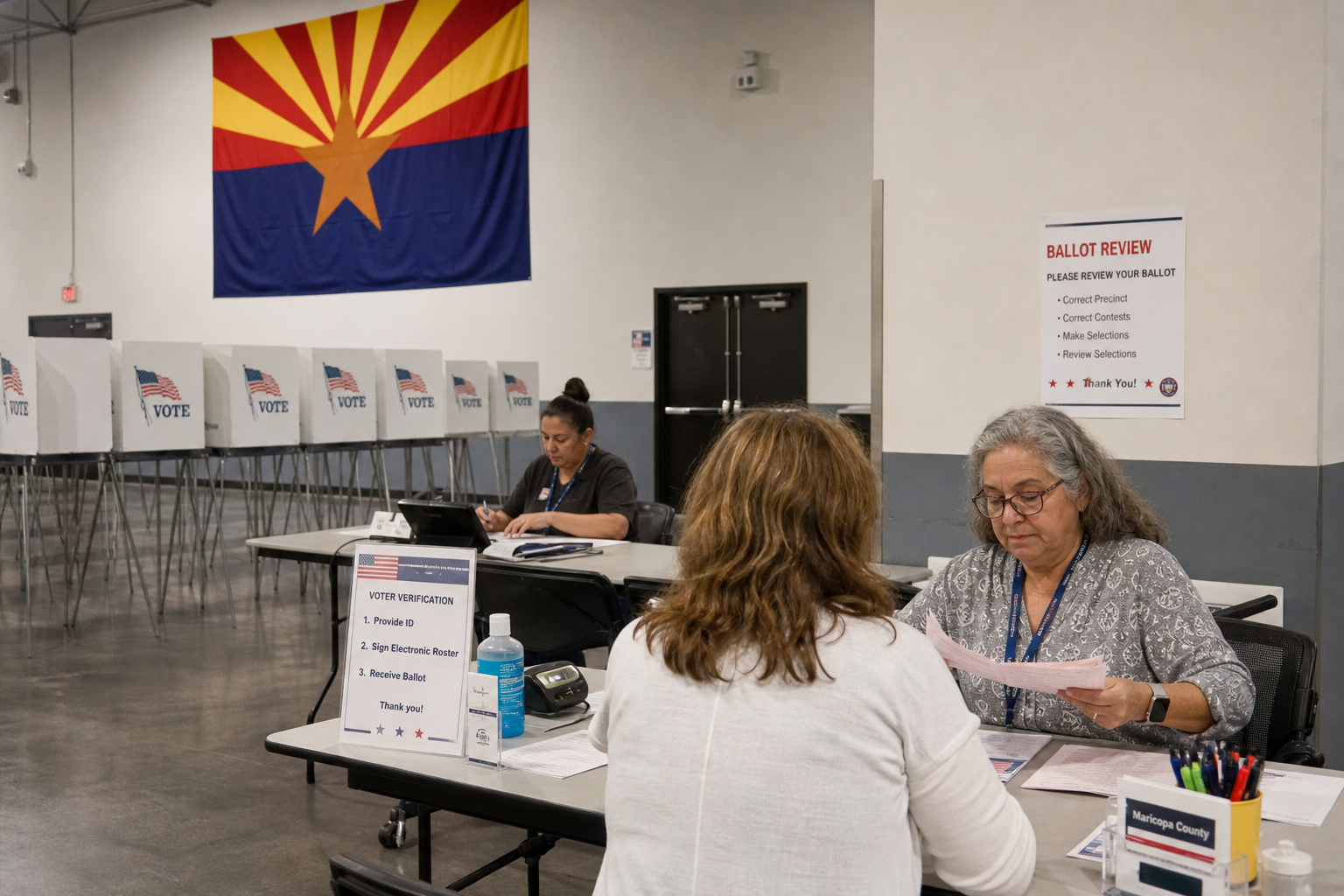
Arizona's Unexamined Voter Roll Problem
Arizona election officials face a narrowing window to reconcile voter registration records with felony conviction databases before the 2026 general election. The gap between who is registered and who is actually eligible to vote is not a new problem. It is a structural one that nobody in county government has the political will to fix.
Here is what we know: convicted felons who have completed their sentences retain voting rights in Arizona only if their civil rights have been restored. That restoration requires a separate legal proceeding, not automatic. Yet Maricopa County's voter roll contains thousands of registrations flagged in the state database as potentially ineligible. Nobody publishes the exact number. Nobody publishes the method by which county election officials verify eligibility before mailing out ballots.
The Verification Problem
I have asked the Maricopa County Recorder's office three times for the specific protocols used to cross-reference voter registrations against Arizona Department of Corrections records. The answer, each time, amounts to: we have a process. Not what the process is. Not how often it runs. Not what happens when a match is found. Just that we have one.
This is the foundation of election integrity in Arizona. Not transparency. Not public documentation. Not an audit trail a losing campaign can examine. A process. A system that works if you trust the people running it, and breaks entirely if you don't.
The problem is not unique to felony eligibility. The Maricopa County Recorder's office maintains the voter roll. County election directors operate vote centers and process ballots. The state Elections Procedures Committee oversees policy. Arizona Secretary of State's office enforces election law. And somewhere in that bureaucratic architecture, the accountability stops.
Why This Matters Now
Election administration should be boring. It should be so routine, so documented, so transparent that nobody questions it. Instead, Arizona elections have become a perennial argument because the system is not built for verification. It is built for speed.
Between now and 2026, Maricopa County could publish monthly reconciliation reports showing how many voter registrations were flagged for ineligibility review, how many were confirmed ineligible, how many were restored, and how the county identified and corrected errors. This would take staff time and political courage. It would not require new law. It would require a decision to do it.
The felon voting question is a proxy for a larger failure: Arizona does not operate its election system as though the losing side has a right to verify the result. Post the chain of custody documents. Publish precinct-level reconciliation totals on election night. Allow any candidate to observe tabulation in real time. Make the signature verification process regular and auditable. Do these things, and arguments about felon voters become technical questions instead of tribal accusations.
What Needs to Change
The Arizona Legislature has the authority to require county recorders to publish quarterly reports on voter roll maintenance. Not just totals. Line-item documentation: how many registrations were challenged, on what grounds, by whom, and with what outcome. It takes no new money. It takes a bill that says: transparency is a requirement, not an option.
County supervisors in Pima, Maricopa, Cochise, and the other 11 counties could demand the same from their recorders through appropriations riders. Tie funding to documentation. Make transparency a line item.
Republican state legislators who campaign on election security and then vote for budgets that do not fund transparency protocols deserve specific attention at primary time. Ask them why they have not introduced this bill. Ask them what they are afraid of learning.
The Structural Question
Election administration in Arizona is decentralized by design. The 15 county recorders run their own operations under state law. That design is defensible. It is not defensible to run it without public accountability.
The felon voting issue will surface again. It will be argued in court. Losing campaigns will cite it as evidence that the system is compromised. And it will return unsolved because nobody with the authority to fix it wants to invest the political capital.
That is the real problem. Not the existence of ineligible voters—that is solvable. But the belief in the agencies that run elections that they can earn public trust by insisting they have nothing to hide while refusing to show anything. They can't.
Mark your calendar for the Maricopa County Recorder's next public meeting. Ask one question: when will your office publish a line-by-line reconciliation of voter roll maintenance decisions? Write down the answer. You will not get one. That silence is the story.
