
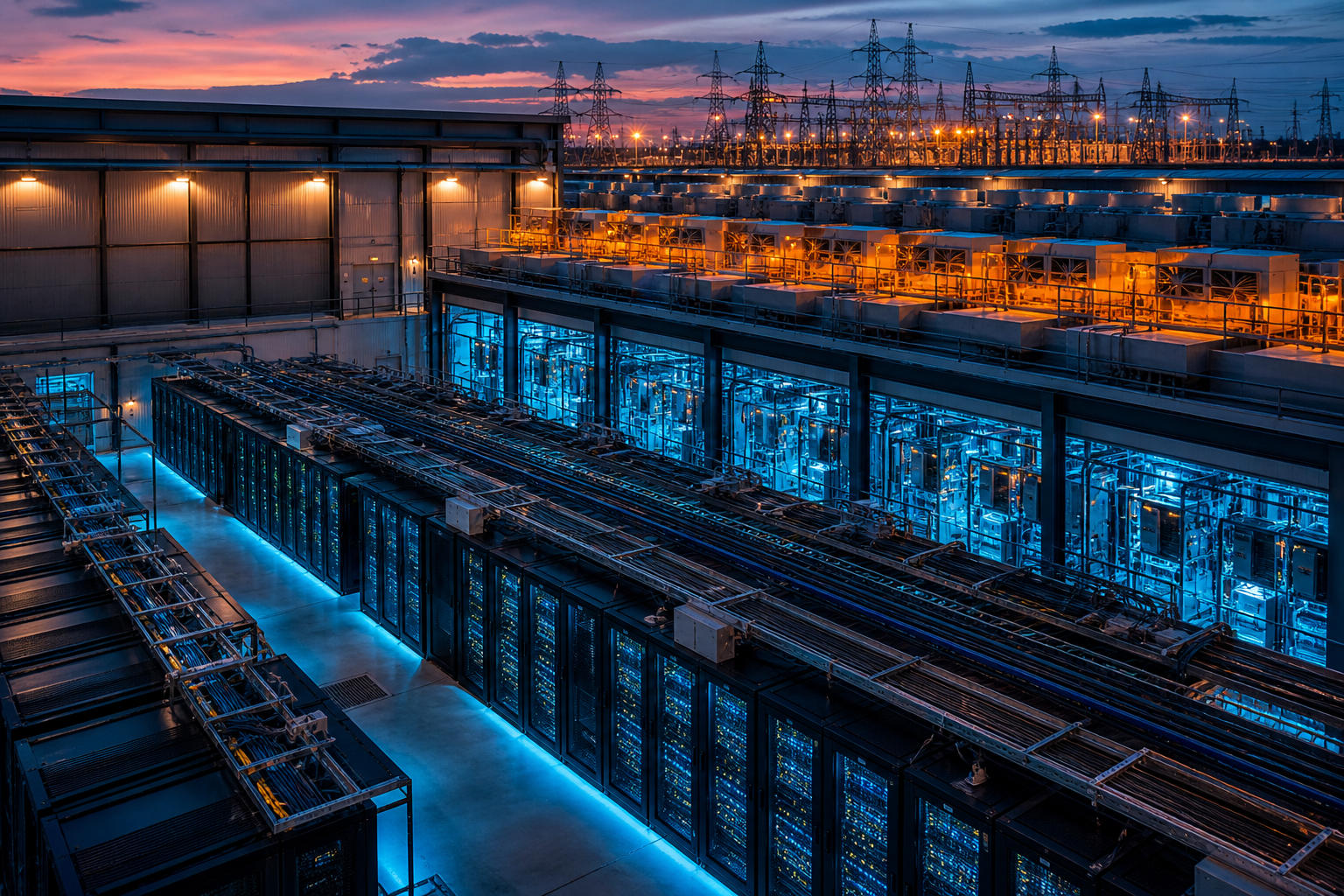
When Private Money Builds What Government Can't
SpaceX announced a $74 billion commitment to data center infrastructure. The company is not waiting for a congressional appropriation. It is not asking your state to bond issue itself into debt. It is making a bet with its own capital that it can build, operate, and monetize computing capacity at scale.
This matters because it reveals something Washington and most state capitals have forgotten: private enterprise, left to compete, solves infrastructure problems faster than regulatory agencies solve them.
The Energy Question Is Real
Large data centers consume enormous amounts of electricity. A major facility can draw hundreds of megawatts continuously. That is not theoretical load — that is the same demand footprint as a small city.
When a private company makes this investment, it has an immediate and measurable incentive to solve the energy problem. It cannot pass the cost to taxpayers. It cannot defer the problem to the next fiscal year. If power is not reliable and affordable, the facility does not pay. The company loses money. That math is unforgiving.
Compare that to the speed of federal or state energy policy. How long did it take Congress to pass an infrastructure bill? How many years have Arizona and California spent negotiating Colorado River shortages? How many environmental impact studies and administrative reviews precede a new power plant?
SpaceX will not wait through that process. It will build data centers where it can secure reliable power at competitive cost. Some of those locations will be in America. Some may not be.
The Regulatory Arbitrage Problem
Here is where the federalism question becomes sharp: states and localities compete for large industrial investment by offering tax abatements, streamlined permitting, and power agreements. That is not corruption. That is federalism working as it should.
But it also means that if one state makes data center investment difficult — through environmental restrictions, power allocation rules, or lengthy review processes — the company simply locates elsewhere. Arizona learned this lesson with manufacturing in the 1980s and 1990s. Texas learned the inverse lesson by keeping energy cheap and regulatory burden light.
When SpaceX chooses a site, it will choose the state that can deliver power, land, and permits without years of litigation. That is not a threat. It is market discipline on bad governance.
What This Means for the Grid
Large data center operators have begun investing in their own power generation. Some build on-site solar and battery storage. Some negotiate long-term power purchase agreements with regional utilities. Some invest in nuclear microreactor technology or negotiate access to existing generation.
This is decentralization through the market, not by government mandate. The company bearing the cost of power reliability is incentivized to diversify its sources and secure its supply. It will not rely on the grid alone if the grid is unreliable.
That reduces demand pressure on the public utility system. It also means the grid operator cannot simply raise rates to cover expanding demand — private facilities have alternatives.
The Labor and Supply-Chain Angle
Data centers require construction, ongoing maintenance, security, and operational staff. Local hiring in the host communities is both a business necessity and a political reality. The company will pay prevailing wages or better, because the market for skilled technical labor is tight.
It will also create demand for materials, services, and logistics. A facility with hundreds or thousands of employees supports restaurants, hotels, and suppliers in the surrounding region. That is real economic activity, not theoretical stimulus.
The jobs here are not subsidized. They exist because the company can operate profitably with them. If automation later replaces some roles, the company will make that change because efficiency matters. That is harder for government to do, because every job cut becomes a press event.
The National Security Dimension
Data center capacity is strategic infrastructure. Artificial intelligence training, cloud computing, and national defense applications all require massive computational capacity. If American companies cannot build and operate world-competitive data centers because permitting takes eight years and power is unreliable, that capacity will migrate offshore.
SpaceX's investment in this space is not primarily patriotic. It is profit-seeking. But the effect is that American capacity remains American-controlled and American-sited, available for national security purposes when necessary.
That is better than a government program that never quite gets built, or a government program that costs twice as much and operates at half efficiency.
The Conservative Policy Implication
This investment is a referendum on deregulation and federalism. If a state makes energy available, land acquirable, and permits processable on a reasonable timeline, private capital arrives. If a state does the opposite, capital goes elsewhere.
That is the entire argument for limited government in one transaction. You do not need to persuade Washington that data centers are important. You do not need a congressional committee. You need a state government that gets out of the way and lets prices signal what matters.
The question for Arizona leadership, Texas leadership, and every state's leadership is simple: When SpaceX chooses, will your state be the choice? Or will you still be holding environmental impact meetings while the facility gets built in another time zone?
Mark the date when the site is announced. Watch which state wins. Then ask your state legislature why it took private capital to solve a problem your government said was impossible.
