
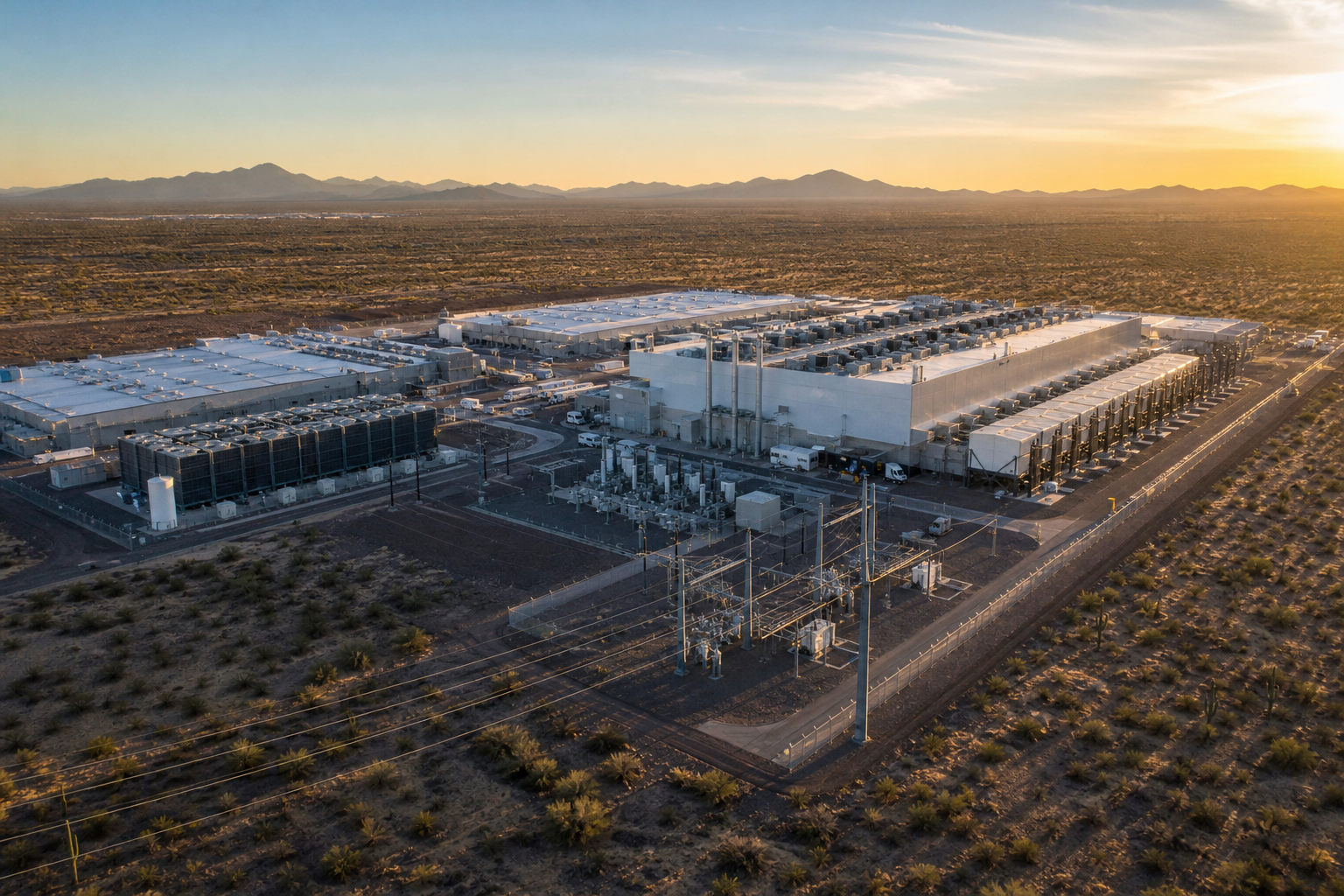
The Data Center Boom Tests Arizona's Power Equation
Arizona is becoming a data center hub. Google, Microsoft, Meta, and smaller operators have announced or expanded facilities across Maricopa, Pinal, and Cochise counties over the past three years. The industry promises jobs, tax revenue, and economic diversification beyond tourism and real estate. The pitch is straightforward: bring the servers, bring the prosperity.
What the pitch does not lead with is the electricity bill. A single large data center consumes as much power as a city of 50,000 people. Arizona's grid is already running tight margins during peak demand months. Add a dozen new facilities, and you add the equivalent load of a mid-size metropolitan area. That load has to come from somewhere.
This is not an abstract problem. It is a question about who pays, who decides, and what happens when an industry's growth outpaces the infrastructure built to support it.
Follow the Power Contracts
Arizona Public Service Company (APS) and Salt River Project (SRP) have negotiated long-term power purchase agreements with incoming data center operators. Those contracts lock in capacity for 20 or 30 years. The facilities get stable pricing. The utilities get stable revenue. Everyone else gets to watch.
Here is what matters: those contracts determine how much power is available for other customers. If APS commits 500 megawatts to data centers over the next five years, that 500 megawatts cannot go to new housing developments, new manufacturing, or new commercial districts. It is spoken for.
The Arizona Corporation Commission regulates both utilities. The ACC has statutory authority to review power purchase agreements for "reasonableness." That is the language in the statute. Reasonableness. Not necessity, not strategic fit, not public input. Reasonableness, as determined by three elected commissioners in Phoenix.
Ask yourself whether "reasonableness" is enough of a gate when you are talking about 30-year commitments of a scarce resource.
The Water Problem Nobody Wants to Say Aloud
Data centers produce heat. All that heat has to go somewhere. Most large facilities use closed-loop cooling systems. Those systems still require water. Not as much as an open-loop plant, but measurable quantities. Millions of gallons per year per facility.
Arizona is in Tier 2 Colorado River shortage. That means Arizona's allocation from the river is already reduced from the 2.8 million acre-feet baseline to 2.4 million acre-feet. Pinal County agriculture—which is entirely dependent on Colorado River water through the Central Arizona Project—is already seeing curtailment orders. Farmers are fallowing fields.
Data center developers say they can use recycled wastewater, groundwater, or reclaimed municipal supply. Technically correct. In practice, those sources are already committed. Maricopa County's municipal water supplies are contractually obligated to supply cities and towns through 2060. Pinal County groundwater is being depleted faster than it recharges. The math does not hide itself if you look at it.
Nobody on the ACC asked hard questions about water sourcing in the contracts they approved last year. Nobody asked because asking would require saying no to somebody important, and the ACC does not make its living that way.
The Economic Case Is Real, But Incomplete
Data centers create jobs. That part is not propaganda. Construction jobs, permanent operations jobs, vendor jobs. A large facility might employ 100 to 150 people directly. Another 300 to 500 in indirect economic activity. The tax revenue to Pinal or Cochise County is material.
For rural Arizona counties, that matters. Cochise County has been losing population and tax base for two decades. Pinal County agriculture is under pressure. Attracting a data center operator is not nothing. It is real money on a real balance sheet.
But the economic case is incomplete if it does not account for the cost side. If bringing in data centers requires upgrading transmission infrastructure that ratepayers fund, that is a cost. If it requires water rights purchases that drive up municipal water costs, that is a cost. If it constrains future growth in other sectors because power and water are spoken for, that is an opportunity cost.
Arizona does not have a consistent process for weighing those costs against the benefits. Each facility is evaluated on its individual merits, not as part of a portfolio. That is how you end up with optimal individual decisions that produce suboptimal collective outcomes.
What Should Happen
Arizona's governor and the ACC should require a comprehensive energy and water assessment before approving any data center power contract larger than 100 megawatts. That assessment should be public. It should show where the water comes from, where the power comes from, what existing commitments are displaced, and what the 30-year cost to ratepayers will be.
It should be presented to county supervisors and city councils in the affected area before the ACC votes. Not after. Before. Let them put it on the ballot if the load is large enough. Let voters decide if they want to trade future growth capacity for current tax revenue.
The data center industry will say that is too slow, too much process, too uncertain. They will be right about the process taking longer. They should be wrong about it being too much. Arizona committed to being a sustainable state when it passed groundwater management law in 1980. Sustainability means planning, not just reacting.
Check the Arizona Corporation Commission website in February. Look at the pending docket items. If there is another data center power agreement waiting for a vote, find out who the three commissioners are. Then call them. Tell them you want to see the water impact statement and the grid load analysis before they decide.
That is how a voter forces accountability into a process that is designed to avoid it. Do it before they sign the contract. After is too late.
