
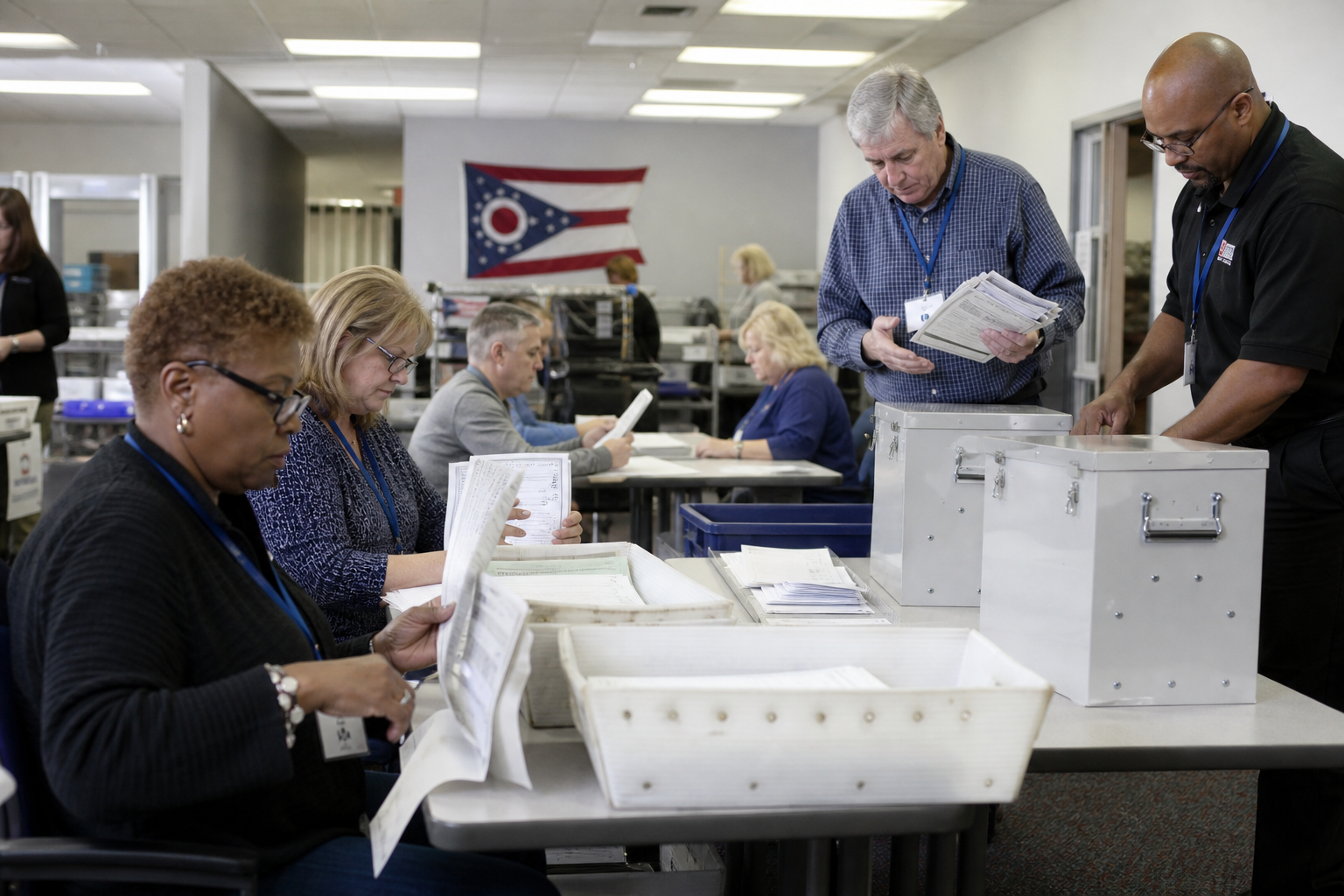
Ohio has put a hard fact back on the table.
Election fraud does happen. Not everywhere. Not at the scale some activists claim without evidence. But it happens enough that serious people should stop treating basic safeguards as an insult.
According to Ohio authorities, investigators uncovered evidence of unlawful voting activity involving eight states. That matters for two reasons. First, because interstate voting misconduct is exactly the kind of problem loose record-sharing can miss. Second, because every case like this tests whether states can identify the illegal vote, remove it from the count where possible, prosecute the offender, and reassure lawful voters that the system still has a pulse.
That is the standard. Not slogans. Not chest-thumping. Not the familiar press ritual where one side says democracy is dying and the other side says every race is suspect. A functioning election system should be able to do two things at once: catch fraud and prove legitimacy.
What Ohio's case actually shows
The first lesson is simple. Voter fraud is usually administrative before it is cinematic.
It is not a movie plot. It is duplicate registrations across state lines. It is an ineligible voter casting a ballot. It is a ballot requested or returned where residency rules were not met. It is a person voting in more than one jurisdiction because the databases did not talk fast enough, or because nobody was checking until after the fact.
That does not make it trivial. It makes it more important.
Small, preventable violations are the kind that corrode public trust over time. If a state cannot stop the basic stuff, you should not be surprised when voters lose confidence in the harder questions.
Ohio's evidence spanning eight states also highlights a federalism problem. Elections are run by the states. That is as it should be. But election crime does not politely remain inside one county line. A voter can move from one state to another. A registration file can lag. A ballot can be cast before one jurisdiction realizes another already recorded activity. The states keep their own books, but the weakness appears in the gaps between them.
The gap is where confidence goes to die.
Why election integrity requires verification, not vibes
Conservatives do themselves no favors when they overstate every problem. The left does itself no favors when it denies there is any problem at all.
The public can see the dodge from both directions.
The serious election-integrity position is narrower and stronger. You do not need to claim massive fraud in every election to argue for cleaner voter rolls, citizenship verification where permitted by law, stronger residency checks, cross-state data sharing, chain-of-custody controls, and timely prosecution.
You need evidence. Ohio says it has some.
Good. Follow it wherever it goes.
If the case proves limited, say so. If it proves wider, say so. If prosecutions follow, publish the names, the charges, and the disposition. If the misconduct changed no outcome, the public should know that too. Transparency is not a concession. It is the whole job.
This is where too many officials fail. They want voters to trust the process while withholding the records that would allow verification. They say the system worked because a case was eventually discovered, but they do not explain how long the misconduct lasted, how many ballots were involved, or what control failed first.
That is not accountability. That is narration.
The policy implications for every state
Ohio's case should push legislatures and secretaries of state toward a basic checklist.
- Regular voter roll maintenance: Dead voters, duplicate records, outdated addresses, and stale registrations should be removed under existing law and with clear notice.
- Cross-state data matching: States need timely comparison systems to identify duplicate registrations and possible double voting without waiting months or years.
- Documented chain of custody: Every ballot batch should be tracked in a way observers can review after the fact.
- Prompt referral for prosecution: Election laws mean little if local prosecutors treat them as optional.
- Public reporting: When fraud is found, the public should get more than a press release. It should get numbers, dates, jurisdictions, and corrective action.
Notice what is not on that list. Panic.
Also not on that list: the fashionable claim that any safeguard is voter suppression. Requiring states to keep accurate rolls is not suppression. Asking whether one person voted in two states is not suppression. Demanding that prosecutors enforce election law is not suppression.
It is administration. Dry, boring, essential administration.
What this means for mail voting and registration policy
The Ohio matter is also likely to renew debate around mail ballots and same-day or automatic registration systems.
Those systems can expand access. They can also expand the need for controls. Both things are true at once. A government that mails ballots widely, updates records unevenly, and shares data slowly is building a system that depends too much on compliance by the voter and too little on verification by the state.
That is backwards.
The burden of election integrity should rest on the system, not merely on the goodwill of participants. Most voters are honest. Election law exists for the minority who are not, and for the bureaucracies that make mistakes. A clean system assumes both realities.
If officials want broad use of absentee and mail voting, then they should welcome stricter auditing, stronger identity checks, and faster interstate record comparison. If they resist those measures, voters will draw the obvious conclusion. Convenience was the priority. Security was the press release.
Republicans should be careful here too
There is a warning for Republicans in this story.
If you run on election integrity, then govern like process does not matter, voters notice. If you demand investigations only when your side loses, voters notice that too. Integrity is either a rule or a tactic. The country has had too much of the tactic.
Conservative lawmakers should be able to explain, in plain English, how their state's registration system is maintained, how duplicates are flagged, how ballots are reconciled, and which agency or county office handles referrals for suspected fraud. If they cannot do that, they are not serious. They are performing concern.
And yes, Democrats deserve scrutiny when they reflexively downplay every case as isolated and therefore irrelevant. A crime does not become acceptable because it was small. Bank robbery remains illegal even when the teller drawer was light.
The point is not to inflate isolated misconduct into national collapse. The point is to prevent isolated misconduct from becoming routine.
The real standard voters should demand
Here is the standard every voter should keep in mind.
You should be able to verify your own loss.
That means a lawful loser in an election should have access to enough transparent process, enough documented custody, enough clean records, and enough post-election reporting to conclude that the result was legitimate even if he hates it. If the system cannot provide that level of proof, it is not sturdy enough.
Ohio's multistate voter fraud findings do not prove every election is corrupt. They prove something more useful. They prove the need for controls is not theoretical.
Eight states is not theoretical. Eight states is not a conspiracy meme. Eight states is a reminder that election integrity lives or dies in the details officials usually hope you will ignore.
The file. The list. The referral. The audit trail. The prosecution.
That is where trust is earned. Or lost.
State lawmakers should mark this now, before the next major federal cycle. Ask your secretary of state what interstate checks are active. Ask your county recorder how duplicates are flagged. Ask your attorney general how many election cases were referred and how many were prosecuted. Then ask for the records.
If the answers come slowly, you have your answer.
