
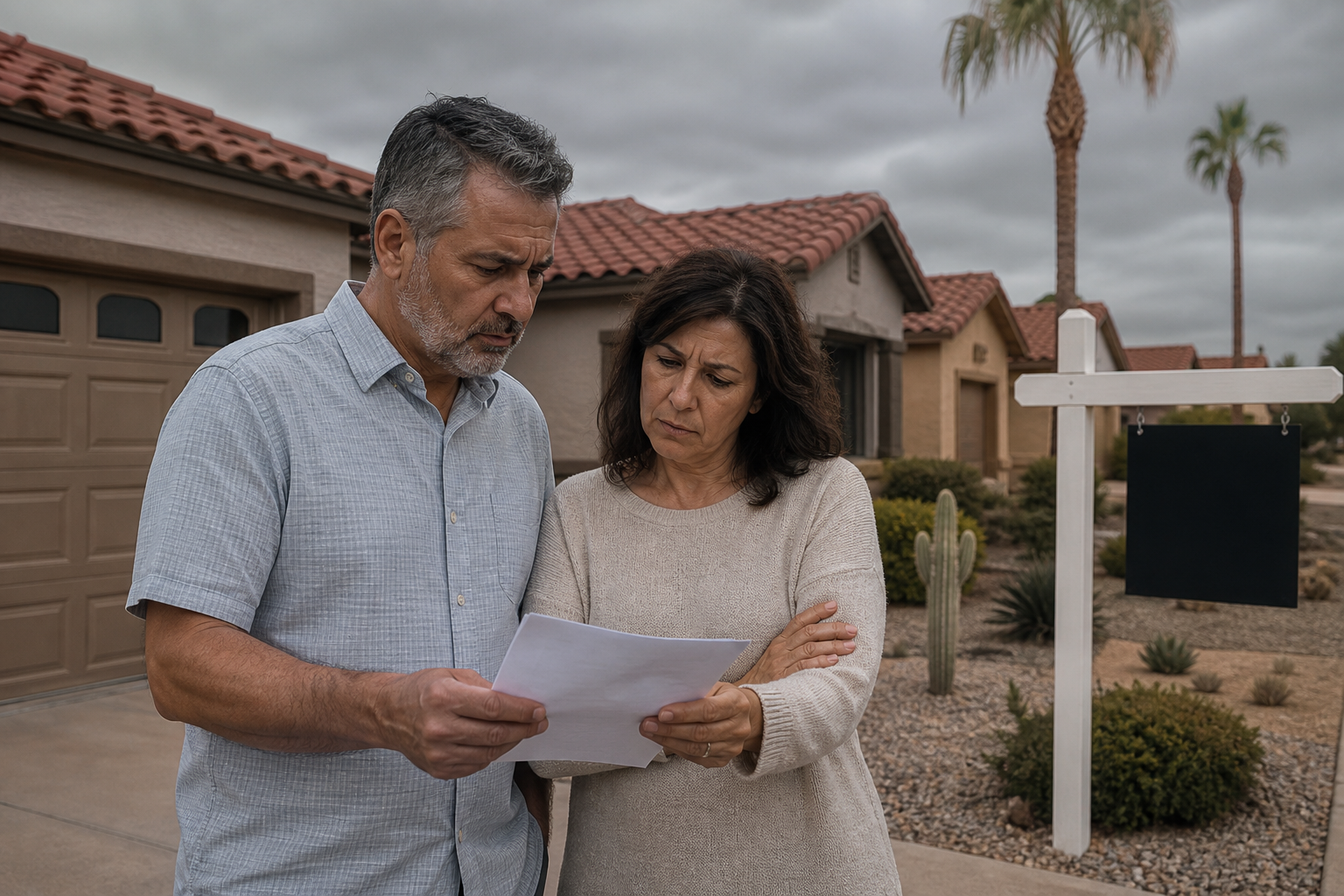
The Arizona Housing Squeeze: What the Numbers Tell You
Drive through Queen Creek or Gilbert on any Saturday morning and you will see the same thing I see when I visit a neighborhood where I know families trying to buy. The 'For Sale' signs stay up longer. The open houses draw smaller crowds. The asking prices do not come down the way they should.
The reason is simple math that nobody in Washington seems to want to say out loud: mortgage rates above 7 percent have removed millions of potential buyers from the market. When a buyer who could afford a $400,000 house at 3 percent interest rates cannot afford that same house at 7 percent, the market does not correct downward in a straight line. It breaks.
Arizona has felt this break harder than most states. In 2021 and 2022, mortgage rates fell as low as 2.75 percent. Buyers flooded in. Prices rose 30 percent in two years across Maricopa County. Construction could not keep up. Inventory dried up. That was the bubble.
Then the Federal Reserve raised its benchmark rate. Twice. Five times. Ten times. The fed funds rate went from near zero to 5.5 percent in eighteen months. Mortgage rates followed. By the end of 2023, rates had climbed past 7 percent. They stayed there into 2024.
The Gap Between Demand and Reality
Here is what you need to understand: home sellers do not want to cut their asking price because they remember what they paid and what their neighbors sold for. But buyers cannot borrow enough money at 7 percent rates to meet those prices. The market stalls. Homes sit on the market 40, 50, 60 days instead of 15. Sales volume in Arizona dropped nearly 20 percent year over year in early 2024.
Meantime, home prices have not collapsed. They have fallen modestly in some areas, but in most of Arizona—Phoenix, Tucson, Flagstaff—prices remain well above where they were in 2020. A first-time buyer in Mesa faces a median home price around $380,000 to $420,000. At a 7 percent rate, that requires household income north of $110,000. The median household income in Maricopa County sits around $85,000.
You do not need a PhD in economics to see what that gap means. It means younger families and working-class Arizonans have been priced out. It means the housing market is no longer allocating homes to people who want to live here and work here. It is allocating them to investors with cash and existing homeowners who can afford to wait.
Why State Policy Cannot Fix This
You will hear Arizona legislators talk about zoning reform and removing regulatory barriers to construction. That is necessary. Pinal County needs more housing. The Santa Cruz Valley needs more housing. Cochise County needs housing if the border towns are going to keep working families instead of watching them move north to Tucson or Phoenix.
But zoning reform does not lower mortgage rates. Building more homes faster does not lower mortgage rates. Those lever belong to the Federal Reserve, and the Fed has chosen to keep rates elevated to fight inflation.
That choice has consequences. When the cost of borrowing money to buy a home climbs 300 basis points in eighteen months, you are not making gradual corrections. You are breaking the market. You are telling a 28-year-old electrician in Queen Creek that the home he could afford in 2021 is now mathematically out of reach, even though the home is the same and his paycheck has not doubled.
The National Policy Problem
Arizona is a bellwether for what happens to housing when federal monetary policy tightens without a corresponding adjustment to fiscal reality. We have the in-migration. We have the job growth. We have the land. We should have the least constrained housing market in the country.
Instead, we have a market frozen between price expectations built on 3 percent money and buyer capacity built on 7 percent money. That is a policy failure, and it sits in Washington, not Phoenix.
The conservative answer to housing affordability is not subsidies or price controls. It is monetary stability and removal of the regulatory taxes that make construction cost 40 percent more than it should. Arizona can control the regulatory side. Federal Reserve policy is not a state matter, but its effects on Arizona families are undeniable.
If you are a Republican primary voter concerned about working families staying in Arizona, mark this: who among your candidates for federal office is willing to say that rate policy this restrictive is the problem? Not zoning. Not immigration. The cost of money itself.
