
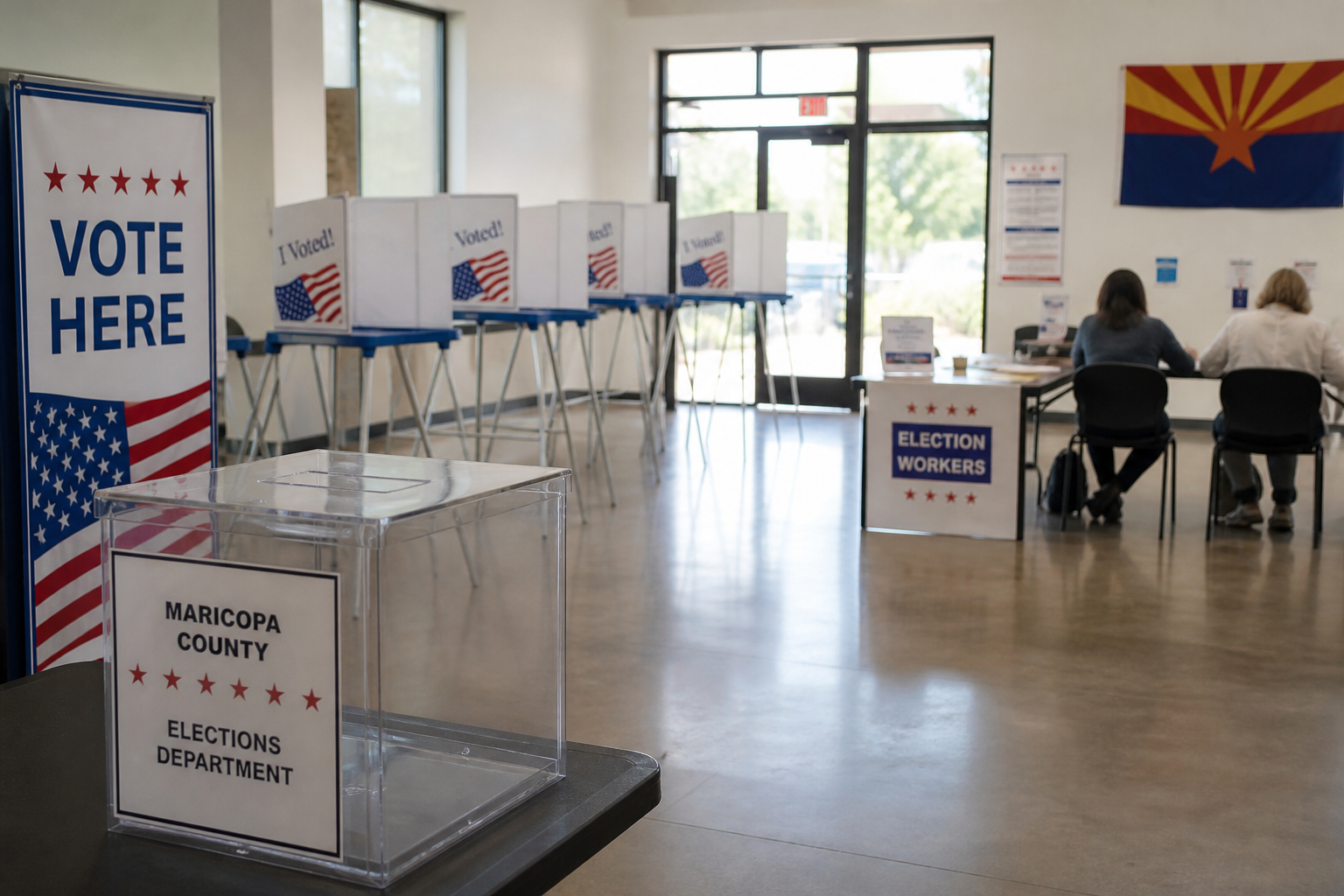
Arizona's Election Security Measure Takes Shape
Arizona is preparing to put an election security amendment before voters this November. The measure would inscribe into the state constitution explicit protections for vote counting procedures, chain-of-custody documentation, and the state's sovereign authority to reject foreign interference in electoral administration.
This is not theoretical governance. This is the floor beneath everything else — the floor that has to hold or nothing else matters.
What the Amendment Actually Says
The proposal requires that all ballots and voting materials remain under secure chain of custody from the moment a ballot is cast until tabulation is complete and reconciliation numbers are certified. It mandates public documentation of that chain. It gives Arizona authority to exclude foreign nationals from any role in election administration, including employment by election offices or contractors hired to manage voting systems.
The amendment also establishes that no court, federal or state, can override Arizona's own election procedures except through the amendment process itself. That matters. It means that when a federal judge tells Arizona how to count votes or which voters to accept, that judge is now operating on borrowed time — and Arizona voters know the mechanism to take that authority back.
It creates a floor for transparency: all reconciliation documents, chain-of-custody records, and voting center data must be available to candidates and election observers within 72 hours of the close of voting. Not months later. Not after litigation. Not after someone's been declared winner.
The Problem This Solves
Arizona has a documented history of opacity in election procedures. The Maricopa County Recorder's office has resisted public release of election night reconciliation data by precinct. Chain-of-custody documents for ballots in some counties have been difficult to access. The state has no unified standard for how long a ballot can sit in a warehouse before being tabulated on election night, or what temperature it sits at, or who logs entry and exit.
These are not partisan talking points. These are procedural facts that appear in county election procedures manuals and are confirmed in conversations with county election officials themselves.
When you cannot see the chain of custody, you cannot verify your own loss. When you cannot access reconciliation numbers until weeks after the election, you cannot identify discrepancies while the system is still warm and documents are still findable. When foreign nationals can hold positions managing voter databases or ballot storage facilities, you have ceded control of the electoral mechanism to people with no constitutional loyalty to the state.
The Constitutional Question
Arizona voters will face a straightforward choice: do you want your state constitution to require that election procedures be transparent enough that you can verify the count yourself, or do you want to rely on the good faith of election administrators and the courts?
That is not a cynical formulation. That is the actual binary. Trust or verification. Faith or documentation. Procedural opacity or procedural clarity.
The amendment is structured as a hard floor, not a ceiling. It does not prevent counties from doing more than the amendment requires. A county could post even more reconciliation data. A county could release chain-of-custody logs in real time. The amendment says you must do at least this much. You must do it in public. You must do it before the election is certified.
What Opposition Will Sound Like
Election officials will argue that transparency creates security vulnerabilities. That if people can see where every ballot is at every moment, that somehow creates an opening for tampering. The opposite is true. Opacity creates the opening. Sunlight closes it.
The federal government may argue that Arizona cannot exclude foreign nationals from election administration. That this violates some interpretation of federal authority over elections. Arizona's response is straightforward: the Elections Clause of Article II gives states the power to determine the time, place, and manner of federal elections. Arizona is determining manner. Arizona is determining that foreign nationals do not participate in its election administration. That is the state's prerogative.
Some will argue the 72-hour reconciliation deadline is unrealistic. It is not. Maricopa County completes tabulation within hours of the close of voting. Providing reconciliation documentation within 72 hours requires only that election officials treat it as a priority rather than an afterthought.
Why This Matters Beyond Arizona
Every state with a meaningful election administration question is watching. If Arizona puts this amendment in its constitution and voters approve it, seven other Republican-controlled states are likely drafting similar language for their 2026 ballots.
This is federalism operating as it should. A state that lost confidence in its own electoral administration is attempting to restore that confidence by raising the procedural bar — not through litigation, not through federal mandate, but through the amendment process.
Mark Your Calendar
Voters will see this as a ballot measure in November. The text will be dense. Read it. If you hold a precinct committee position, your voters will ask you about it. Know what it says.
If you lost an election and thought the system lacked transparency, this is the mechanism to fix it. If you think the current system works fine, you still need to read it, because the burden is on you to explain why chain-of-custody documentation should not be public.
Arizona voters will decide whether procedure matters or whether it does not. That is not a small question.
