
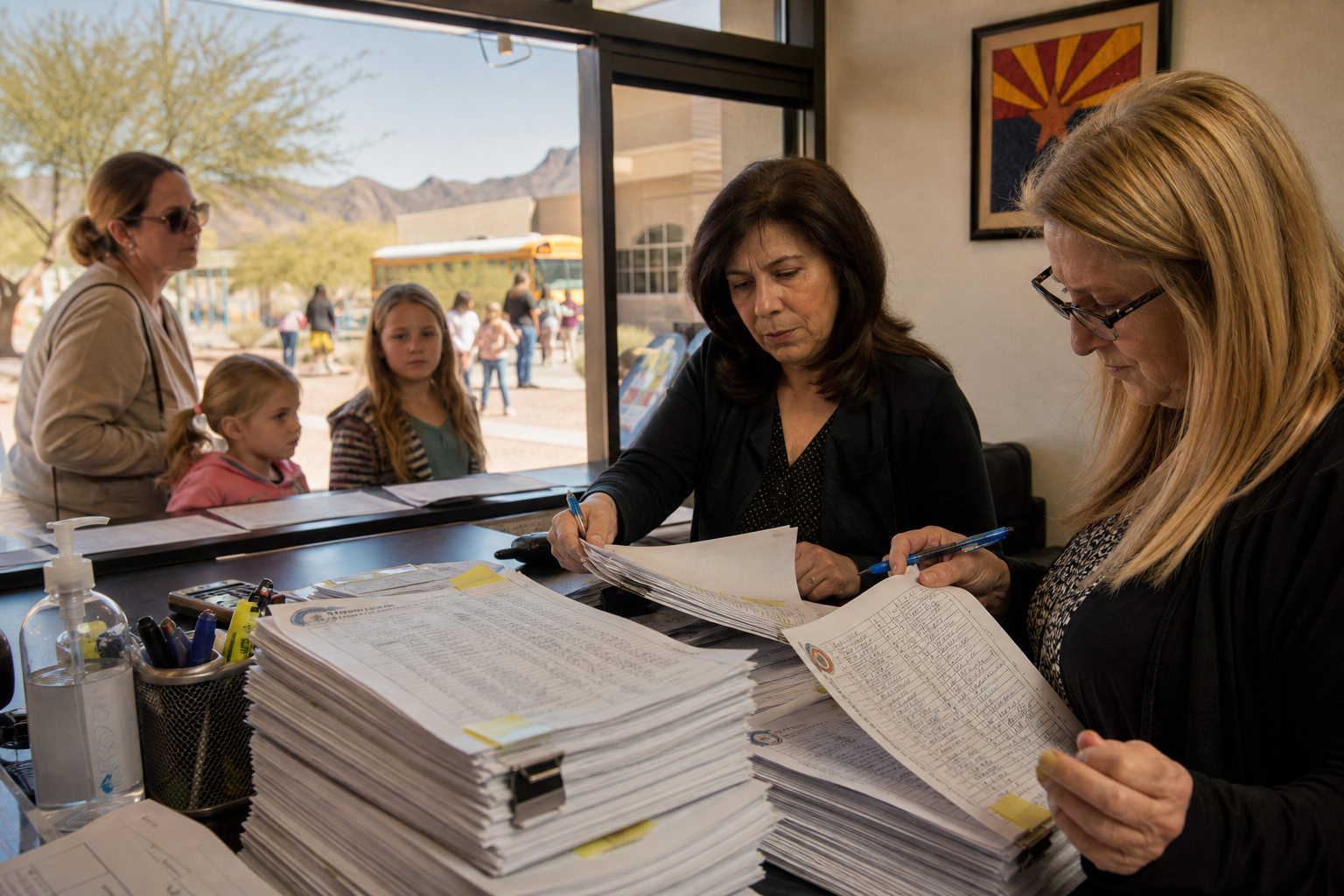
Arizona's school choice fight is back where many of these fights end up: in court, over signatures, deadlines, and whether the paperwork behind a ballot drive can survive scrutiny.
This time the target is the state's Empowerment Scholarship Account program, better known as ESA. Opponents have tried for years to stop, narrow, or politically isolate the program. Now a ballot initiative or referendum effort tied to that fight is facing legal challenge over allegations of signature fraud.
That phrase gets thrown around too loosely in politics. It should not be used loosely here. If the allegation is real, it is serious. If it is overstated, the courts should say so quickly. Either way, the standard has to be the same for everyone: if you want a place on the ballot, you follow the law, line by line, signature by signature.
What the case is really about
On the surface, this is a dispute over petition signatures. Underneath, it is a test of whether Arizona's direct democracy process can remain credible in a state where ballot warfare has become a permanent industry.
Arizona allows voters and advocacy groups to use initiatives and referenda to challenge laws or write new ones. That power matters. It also depends on clean execution. Petition circulators have rules. Signers have rules. Filing deadlines have rules. Counties and the Secretary of State have verification duties. None of that is optional because the cause is fashionable.
When a challenge alleges forged names, false circulator practices, or invalid signatures gathered in volume, the issue is no longer just school choice. The issue is whether the ballot itself is being built on a chain of custody the public can trust.
You cannot demand integrity in general elections and then shrug at petition integrity because your side likes the policy outcome. Same rule. Same standard. Same scrutiny.
Why ESA remains a political target
The reason this fight is so intense is simple. Arizona's ESA program is one of the most significant school choice policies in the country.
The program allows eligible families to use state education dollars for approved educational expenses outside the assigned public school system. That can include private school tuition, tutoring, curriculum, therapies, and other education-related costs authorized under state law. Supporters argue it gives parents direct control and creates an escape hatch for families trapped in underperforming schools. Critics argue it shifts money away from district schools and opens the door to weak oversight.
Conservatives should be clear about the principle here. The money is for the child's education, not for the preservation of any one institution. That is the dividing line. Once you understand that line, the rest of the debate gets simpler.
Parents are not a transportation mechanism for a system. They are the primary authority over the child's education. The state exists to support that duty, not reverse it.
Petition integrity is not a technicality
Expect the defenders of the ballot drive to say the legal challenge is a political tactic. Sometimes those claims are true. Sometimes campaigns use litigation to bleed the clock and knock opponents off the ballot on narrow grounds.
But forged or improperly gathered signatures are not narrow grounds. They go to the legitimacy of the filing itself.
Arizona has seen repeated controversies over signatures in candidate races and ballot measures alike. That is not because the rules are obscure. It is because the incentives are obvious. Petition operations are expensive. Deadlines are tight. Paid circulators are under pressure. Large signature counts create room for bad practices. That is exactly why the courts are there.
If a campaign cannot prove it met the legal threshold with valid signatures, it should not be on the ballot. Not close. Not mostly. Not by good intentions. By valid signatures.
The policy stakes for Arizona families
If this challenge succeeds, school choice supporters will treat it as more than a legal win. They will treat it as a warning shot to future campaigns that try to use the ballot to unwind legislative policy without meeting basic procedural standards.
If the challenge fails and the measure advances, the next phase will be even more expensive and more brutal. You can expect a statewide messaging war built around two competing claims: one side saying ESA empowers families, the other saying it drains traditional public schools.
That is the public argument. The actual policy question is more concrete.
Do parents decide where education dollars work best for their own child, or does the system decide and call it equity?
That is the whole fight.
ESA critics usually speak as if every dollar not routed through a district account has been stolen from public education. That is not analysis. That is institutional self-defense. District schools are one delivery model. They are not the child. They are not the right. The child is the right-holder. The parent is the steward.
What courts and election officials should do now
The immediate need is speed and transparency.
Courts should move quickly, because ballot cases delayed too long stop being legal review and start becoming managed confusion. Election officials should document every step of the verification process with enough clarity that both sides can understand why signatures were counted or rejected.
That means public confidence depends on more than a final number. It depends on process people can inspect. Arizona has had enough election-adjacent fights where officials ask the public to trust that professionals handled it. Trust is not a system. A visible process is a system.
If there are fraud allegations, show the basis. If there are invalid sheets, identify the defect. If signatures fail review, explain the category. The public can handle detail. What the public cannot handle is institutional vagueness followed by lectures about disinformation.
Republicans should not get lazy
There is one more point for Republicans.
Winning a procedural fight does not relieve lawmakers of the duty to defend ESA on the merits. Too many elected Republicans treat school choice as a line item to protect in budget season and a slogan to dust off at campaign time. Parents need more than that.
The program needs oversight that is real, not performative. Fraud inside the program should be investigated. Ineligible spending should be stopped. Administrative delays that trap families in paperwork should be fixed. A conservative case for school choice gets stronger when it is paired with competence.
That is not a concession to the left. That is what governing looks like.
The bigger lesson
Arizona is now a state where nearly every major policy fight becomes a ballot fight, a court fight, or both. Water. Taxes. Elections. Abortion. Education. The procedural fight is now part of the policy fight.
So mark the lesson.
If you care about school choice, you should care about petition integrity.
If you care about election integrity, you should care about petition integrity.
If you want the public to accept losing fairly, you build processes that can be checked.
That applies to counting ballots in November. It applies to gathering signatures in July. And it applies whether the cause is your cause or the other side's.
The courts will sort out this case on the facts. They should. But politically, the shape of the fight is already clear. Arizona's school choice program remains a live target, and its opponents are still looking for a route around a Legislature that has protected parental control in education.
Parents should pay attention now, not after the ballot language is printed.
Watch the court calendar. Watch the signature count. And watch which politicians talk about parents while siding, once again, with the system over the family.
