
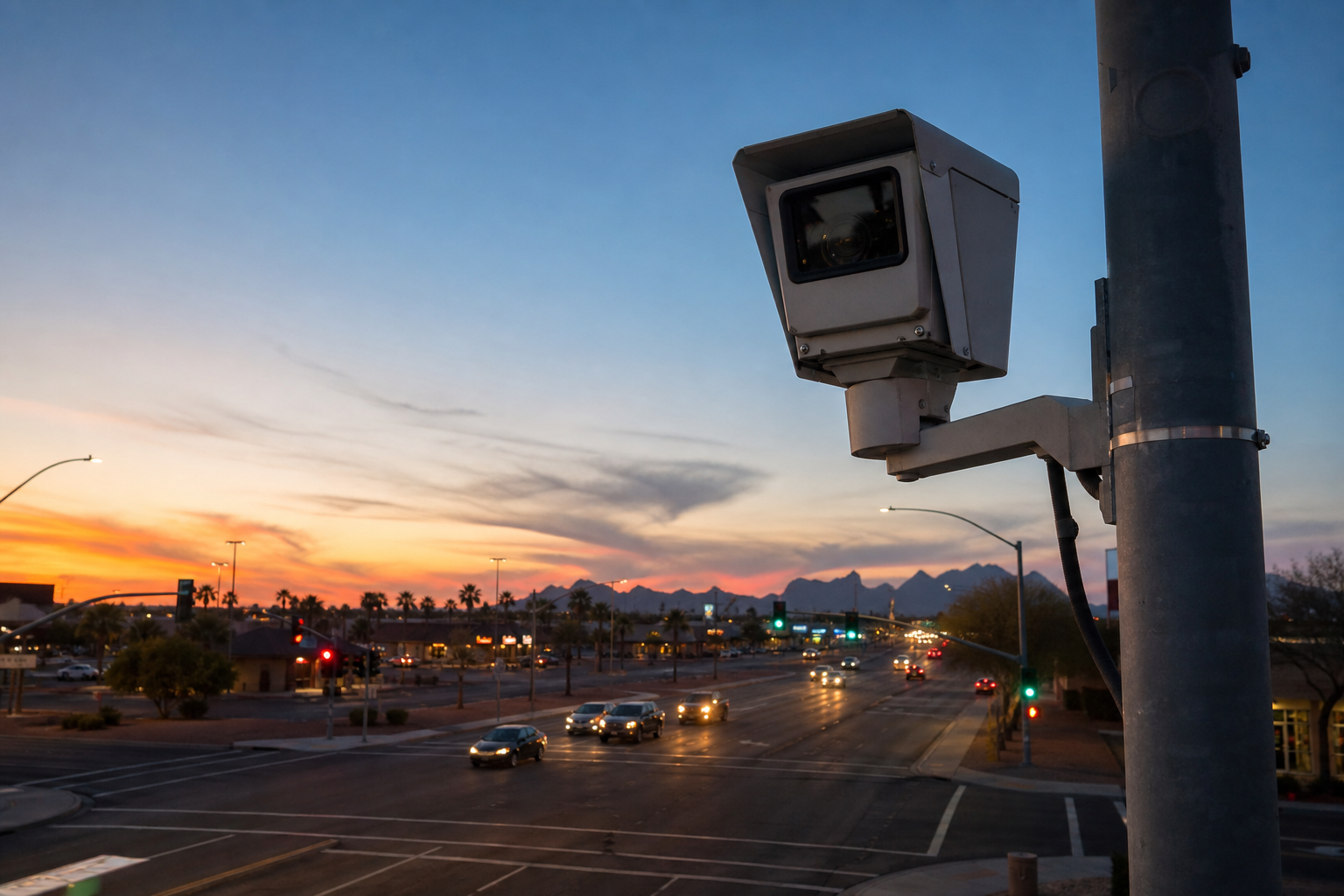
Arizona's Expanding Automatic License Plate Reader Network
Phoenix, Scottsdale, and several Maricopa County municipalities have deployed Flock Safety cameras and similar automatic license plate reader (ALPR) systems across residential neighborhoods, commercial corridors, and highway corridors over the past three years. These cameras photograph and digitally catalog every vehicle that passes them, creating a searchable database accessible to law enforcement agencies without a warrant, without notice to the vehicle owner, and without public record available to the citizens whose streets are being monitored.
This is not traffic enforcement. This is mass surveillance operating under a business model that treats your vehicle as a data point.
How the System Works and Who Controls Access
An ALPR camera captures a photograph of every license plate within its field of view. That photograph is immediately digitized, cross-referenced against lists of vehicles associated with criminal activity, and stored in a searchable database. Law enforcement can query the database by plate number, vehicle description, or date and time. A detective looking for a car that was present at a crime scene can search the entire ALPR network for weeks back to find which vehicles were in that location when the crime occurred.
That sounds reasonable until you realize what it means in practice. Every vehicle that drove past that location is identified and cataloged. Every commuter. Every parent picking up a child from school. Every person visiting a medical clinic or a church or a domestic violence shelter in that neighborhood. The system does not distinguish between suspects and innocent people. It records everyone.
The data is stored on Flock Safety's private servers. Flock is not a government agency. It is a private company incorporated in Georgia. Arizona cities contract with Flock to install cameras, and Flock retains the data. Police departments in Phoenix, Scottsdale, Mesa, Chandler, and other municipalities have access to query the Flock database. There is no unified public record of how often those queries occur, who is making them, or what happens to the data once a query is complete.
The Constitutional Problem
The Fourth Amendment protects against unreasonable searches. A search requires either a warrant based on probable cause or consent. An ALPR system collects information about the movements and location of every person who drives on a public street. That information, collected systematically and stored permanently, is the kind of surveillance the Framers designed the Fourth Amendment to prevent.
In 2018, the U.S. Supreme Court held in Carpenter v. United States that the government cannot demand cell-site location records without a warrant, even though those records are held by a private company. The court said the quantity and specificity of location data triggers Fourth Amendment protection. A person's movements over time reveal a pattern of life—where you work, where you worship, where you receive medical care, where you meet friends.
An ALPR network does exactly that. It tracks your movements in real time and stores that record indefinitely. Yet Arizona cities are deploying these systems without warrants, without legislative authorization, and without public notice.
Oversight Is Minimal and Fragmented
Phoenix's city council has not passed an ordinance regulating ALPR deployment or access. Scottsdale's police department operates Flock cameras under a contract that was not subject to public hearing. There is no state law in Arizona requiring cities to disclose ALPR locations, to obtain City Council approval before installation, or to report statistics on searches and data access.
Individual police departments have internal policies. Some limit ALPR queries to active criminal investigations. Others allow queries for minor traffic violations or civil disputes. None of these policies are uniformly enforced, and none are visible to the public before a query happens.
This is bureaucratic surveillance. It operates because no law explicitly forbids it. No mayor or police chief had to stand in front of voters and defend it. It expanded because it was technically possible and because the vendor—Flock—marketed it as a public safety tool without mentioning that it is a searchable database of everyone's location data.
What Happens to the Data
Flock's privacy policy states that it retains images for a default period of 30 days unless a police department requests longer retention. Some Arizona departments have requested retention of 60 days, 90 days, or longer. The longer the retention period, the more complete the map of where you have driven.
Flock also sells its data to insurance companies, auto recovery services, and in some cases, to federal agencies. The company says it anonymizes the data before sale, but it provides enough information that someone with access to multiple data points can reconstruct a vehicle's movements across multiple agencies' networks.
This is not a supervised government database. This is a private company storing intimate location data about Arizona residents and monetizing it.
What Happens Next
Two things need to occur. First, the Arizona Legislature should pass a law requiring any municipality that deploys ALPR systems to obtain explicit City Council or Town Council approval by ordinance, to disclose camera locations to the public, to publish quarterly reports on the number of queries and the legal justification for each, and to require a warrant before any query of the ALPR database unless a life is in immediate danger.
Second, if a city already has deployed ALPR cameras, its residents should demand a public accounting. Ask your city councilman or councilwoman how many cameras are operating in your neighborhood. Ask for the Flock contract. Ask how many queries were made in the past year and on what grounds. Ask whether your city has a warrant requirement policy.
The answer will tell you whether your city government believes your Fourth Amendment rights are worth protecting or whether it treats you as a surveillance subject to be tracked for administrative convenience.
Your next city council meeting is the place to ask it. Bring the contract. Bring the questions. Bring neighbors. The camera is already watching. Make sure someone is watching back.
