
Maricopa County is not dealing with a technical problem alone. It is dealing with a legitimacy problem.
That is more serious.
After several election cycles marked by printer failures, long lines, delayed reporting, ballot disputes, and endless arguments over process, county officials have been trying to restore public confidence. The stated goal is straightforward: show voters how the system works, explain where earlier failures happened, and make the process visible enough that fewer people assume the worst.
That effort matters. But it also has limits.
You do not rebuild trust in elections by asking people to calm down. You rebuild it by giving them more to inspect, more to verify, and fewer reasons to wonder what happened behind a closed door.
Confidence Is Now a Core Election Issue
Maricopa County sits at the center of Arizona politics for a reason. It is the state’s largest county, home to most of its voters, and the place where administrative mistakes turn into statewide political shockwaves.
That means even routine election functions carry unusual weight. A delayed tabulation update in a small county is a local story. A delayed tabulation update in Maricopa becomes a national story. The same is true for ballot-on-demand printer failures, chain-of-custody questions, and public confusion over what happens to ballots that cannot be immediately tabulated at a vote center.
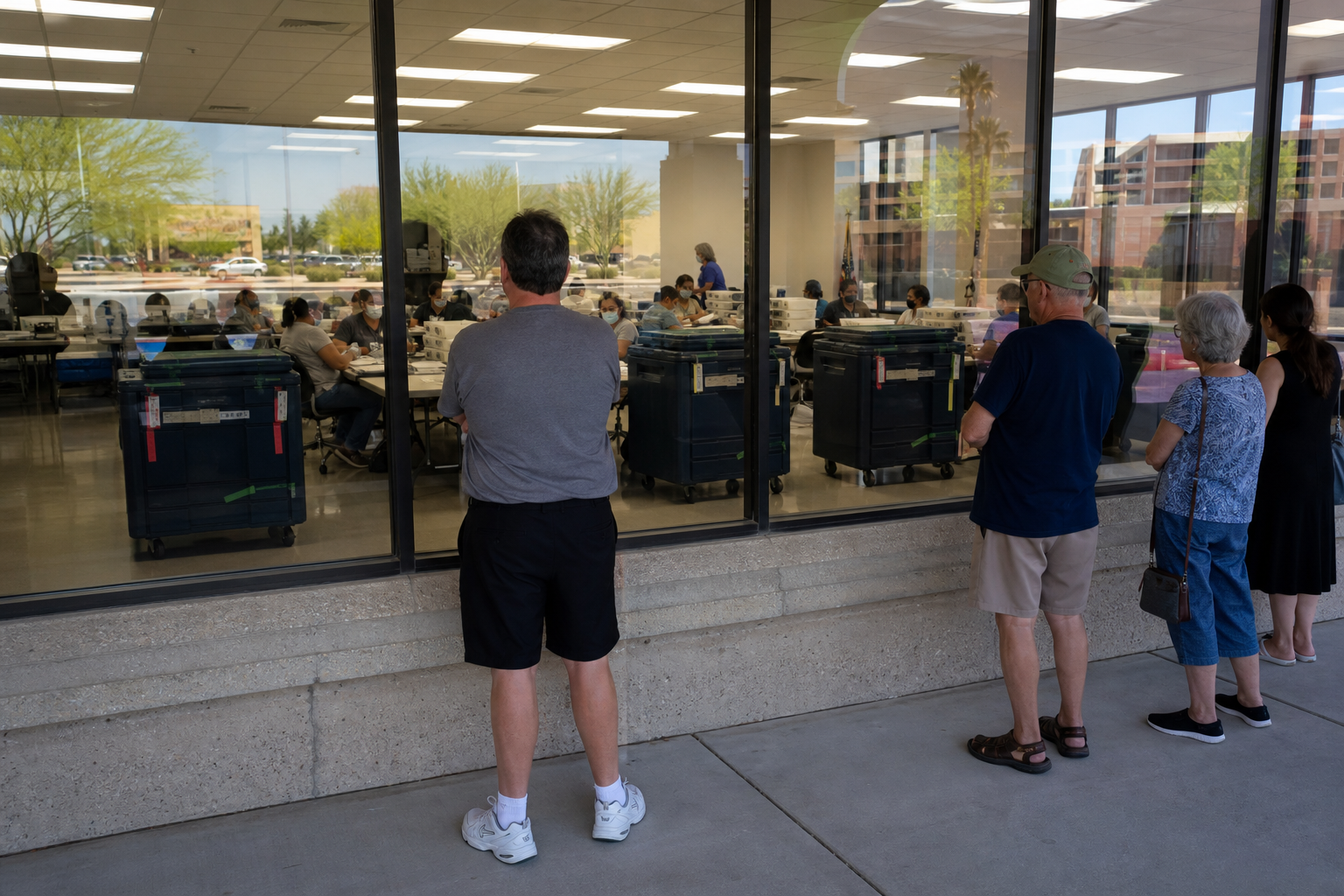
County officials know this. That is why much of the current effort has focused on transparency measures rather than just internal management. Public tours. Expanded procedural explanations. More detailed briefings. Better descriptions of how ballots move from vote centers to central count. More emphasis on bipartisan staffing and physical security controls.
All of that is useful. None of it is enough by itself.
Transparency Has to Mean More Than a Presentation
There is a difference between public relations and public accountability. Maricopa County has to be careful not to confuse the two.
A press conference can explain a process. It cannot substitute for proof.
A facility tour can show voters where ballots are handled. It cannot answer every question about reconciliation, custody logs, adjudication standards, or the timing of batch reporting.
If the county wants lasting improvement in voter confidence, it needs to keep moving toward records that are timely, standardized, and public by default. That includes basic things conservative voters have been asking for for years: clearer ballot accounting, faster publication of reconciliation data, and documentation that can be independently reviewed without a public-records fight.
This is the key point. Trust is weakest where verification is hardest.
And in Maricopa, verification has often felt too slow, too technical, or too dependent on the voter accepting the county’s explanation after the fact.
What County Officials Appear to Understand Now
To be fair, county leaders do seem to understand one reality that much of the political class ignored for too long: public confidence is not restored by scolding the public.
That was the old habit. If voters raised concerns, they were often told they were misinformed, conspiratorial, or unable to grasp a modern election system. Some criticisms were unfair. Some were flatly wrong. But that did not change the larger problem. When a system is complicated, opaque in parts, and visibly strained on Election Day, skepticism is not irrational. It is predictable.
So the better approach is the one Maricopa appears to be moving toward now. Explain the process before Election Day. Open the process during Election Day. Publish as much as the law allows after Election Day. Repeat it. Repeat it again. Then do it in a way a normal voter can follow without needing a law degree or a data consultant.
That is not a partisan ask. It is basic democratic hygiene.
The Printer Failure Lesson Still Matters
Any serious discussion of voter confidence in Maricopa has to begin with the 2022 midterm election and the ballot-on-demand printer failures at some vote centers. Those problems became a symbol of something larger.
Not because every criticism that followed was proven. Not because every allegation was sound. But because voters watched a system fail in real time.
That is what people remember. They remember waiting. They remember being told to try another location. They remember hearing that ballots placed in secure boxes would be transported and counted later. They remember confusion.
Once that happens, the burden changes. The county no longer gets to say, in effect, trust us, the professionals are handling it. The county has to show, step by step, how the problem has been corrected and how the backup procedures work if something fails again.
This is where confidence is won or lost. Not in broad claims. In operational detail.
Why Republicans Keep Pressing the Issue
Some in the press still treat election confidence concerns as little more than a factional Republican obsession. That is lazy.
Republicans keep pressing the issue because process matters, because close elections magnify administrative failure, and because transparent procedure is the only way to make losing voters accept a loss they did not want.
That last part is not optional.
In a healthy system, the loser can check the work. That should be the standard. Not perfect emotional acceptance. Not universal agreement. Checkable procedure.
Conservatives are right to insist on that point. If anything, they should insist on it more precisely. Less heat. More specifics. More focus on chain of custody, equipment testing, vote center capacity, adjudication rules, tabulation reporting, and reconciliation. Those are the places where reform either exists or does not.
The Policy Implication for Arizona
The larger lesson for Arizona is simple. Election administration cannot operate on technical compliance alone. It has to operate on public credibility.
If the law allows practices that are technically valid but publicly confusing, lawmakers should revisit them.
If county reporting standards differ in ways that create unnecessary suspicion, the Legislature should look at uniformity.
If critical records can be delayed, fragmented, or released in formats that ordinary citizens cannot use, that is not transparency in any meaningful sense.
Maricopa County can improve its own operations. It should. But some fixes belong to the state. Arizona lawmakers who claim to care about election integrity should spend less time performing outrage and more time writing rules that make election records easier to audit in public view.
That would help counties and voters at the same time.
Restoring Confidence Will Take More Than One Cycle
No county press rollout is going to erase years of distrust. No procedural memo is going to settle every argument. And no amount of official reassurance will satisfy people who believe the system has already failed beyond repair.
But that does not mean the effort is pointless.
It means the standard has to be realistic. Maricopa County is not trying to produce universal agreement. It is trying to produce enough visible competence and enough public proof that more voters, including skeptical voters, conclude the process can be checked.
That is the threshold that matters.
If county officials want to get there, the formula is not mysterious. Fewer black boxes. Faster disclosure. Cleaner records. Better Election Day performance. More public visibility into the steps between cast ballot and final count.
In other words, do not just defend the system. Let the public inspect it.
That is how confidence returns. Slowly. Unevenly. But for real.
And in Maricopa County, after the last several years, real is the only kind that counts.
