
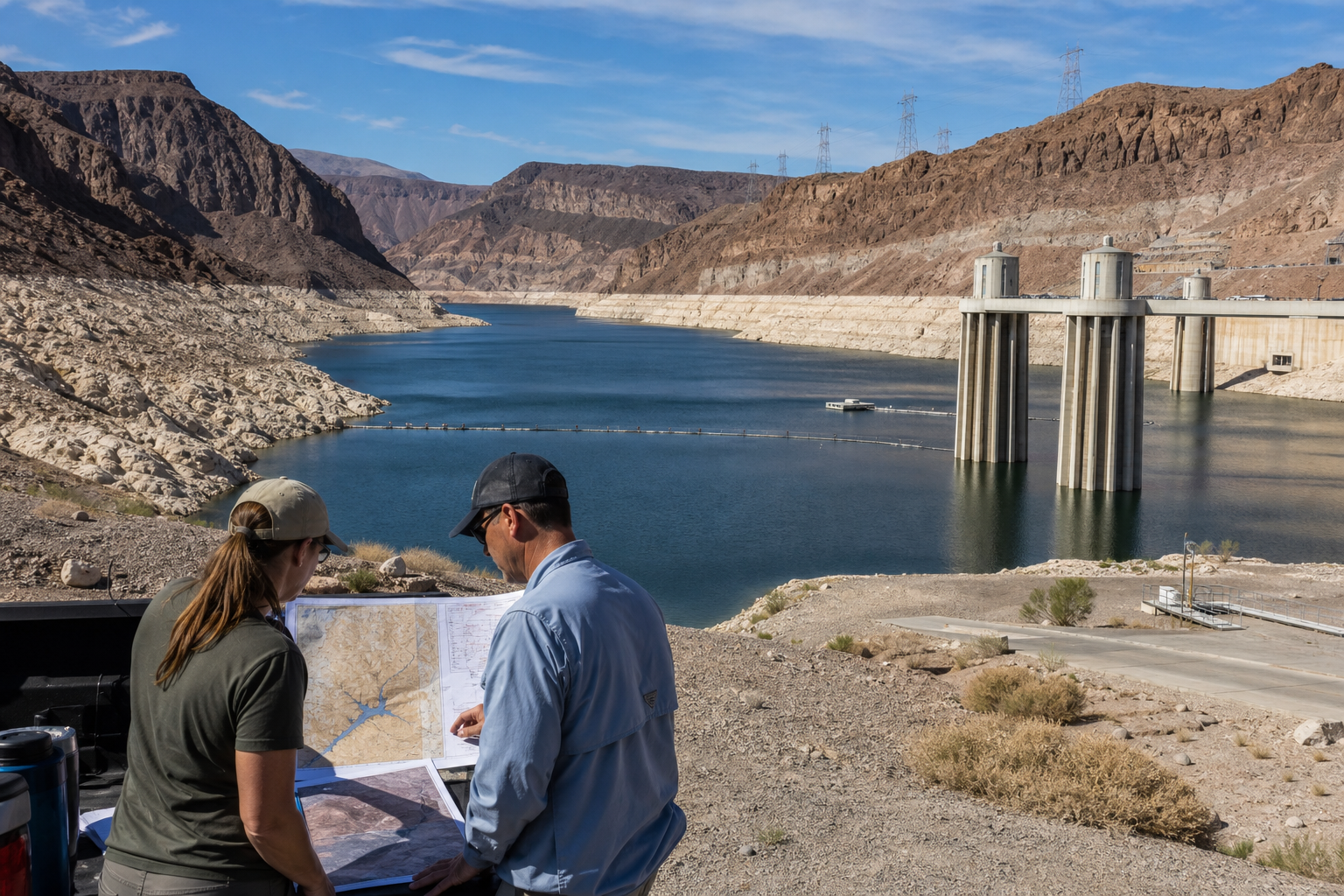
The Colorado River is not just a river. It is a legal system, a farming system, and an energy system. When the federal government announces a new operating agreement, seven Western states do not just get a policy memo. They get a warning.
The warning is simple. The old assumptions are over. Less water in the system means every state now has to ask the same question: who gives up how much, and who decides?
What a federal Colorado River agreement actually means
Any federal agreement tied to the Colorado River usually concerns reservoir operations, shortage sharing, conservation commitments, or emergency releases tied to major storage projects such as Lake Mead and Lake Powell. Those decisions matter because the federal government, through the Bureau of Reclamation, operates the key infrastructure. But operation is not the same thing as unlimited authority. That distinction matters.
The river is governed by a layered arrangement often called the Law of the River: interstate compacts, federal statutes, court decisions, treaty obligations with Mexico, and administrative rules. It is complicated on purpose. Every piece was built to protect somebody's claim.
That is why every new agreement produces the same public language about collaboration and stability, followed by the same private fight over risk allocation. Someone's district loses flexibility. Someone's farmers lose certainty. Someone's utility loses a margin of safety.
You should notice what happens next. Washington presents the deal as technical management. States experience it as a shift in power.
Upper Basin and Lower Basin states are not carrying the same burden
The first fault line is geographic. The Upper Basin states — Colorado, Wyoming, Utah, and New Mexico — manage a different set of risks than the Lower Basin states of Arizona, Nevada, and California. The Lower Basin has long depended on massive storage and large delivery systems. It also includes some of the biggest population centers and some of the most politically protected water users in the West.
Arizona voters know this reality well. The state has spent years confronting reduced Colorado River supplies while still trying to absorb population growth, maintain agricultural production, and preserve long-term industrial development. In central Arizona, every policy discussion eventually reaches the same point: water that does not exist cannot be allocated by press release.
California enters these talks with older and often stronger legal claims in many sectors. Nevada has comparatively less water but immense urban pressure. Arizona sits in the middle of the squeeze. It has junior rights in important places, major municipal needs, and a political class that too often talks about innovation when arithmetic would do.
Arithmetic first. Politics second. That would be a nice change.
Why energy policy is attached to a water deal
This is where many readers outside the basin miss the story. A Colorado River agreement is also an energy story because the river system supports hydropower generation at federal dams, especially Hoover Dam and Glen Canyon Dam. When reservoir levels fall, the system does not just lose water storage flexibility. It can lose generating efficiency and, in more severe conditions, generating capacity.
That matters for grid operators and ratepayers across the region. Hydropower is valuable not only because it is relatively low cost when available, but because it can respond quickly to changes in demand. In a grid increasingly shaped by intermittent generation, dispatchable power matters more, not less.
If reservoir levels continue to strain hydropower output, utilities will have to replace that power somewhere else. Usually that means natural gas, market purchases, or new infrastructure costs passed to customers. The family opening its summer electric bill in Phoenix does not care whether the shortfall came from an environmental regulation, a weak snowpack, or a bad federal bargain. The family just sees the number.
The number still arrives. The number always arrives.
Federal control expands when states fail to act together
There is a broader conservative lesson here. Administrative power grows fastest where elected officials leave a vacuum. If basin states cannot produce a durable framework, federal agencies will fill the space through emergency orders, operating rules, environmental review leverage, and negotiated compliance structures that look temporary until they become permanent.
That should concern anyone who claims to believe in federalism. Interstate water compacts exist because states are supposed to govern shared resources through accountable, negotiated limits. Once the process shifts too far into agency management, the public gets less visibility and less recourse.
You see the same pattern in Arizona water fights all the time. Rulemaking file. Technical memo. Public meeting during the workday. Then a decision with billion-dollar consequences arrives dressed up as process. The process is real. So is the power transfer.
Conservatives should not oppose every federal role on reflex. The federal government does own and operate major river infrastructure, and drought response requires some central coordination. But coordination is not a blank check. If a new agreement effectively rewrites long-term expectations for states, legislatures and governors need to say so plainly and respond in public.
Agriculture will bear pressure first, even when cities drive demand
In most Western water negotiations, agriculture is the first target because it is the largest consumptive user and because urban political coalitions are more organized, more media savvy, and closer to the centers of state power. Some reduction in agricultural use may be unavoidable in a smaller river system. But policymakers should be honest about the tradeoffs.
When irrigated acreage contracts, the impact does not stop at the farm gate. It hits processors, truckers, equipment dealers, feed suppliers, tax bases, and local schools. In Arizona and across the West, rural communities are routinely asked to absorb losses so metro growth can keep moving. Then the same officials act puzzled when those communities stop trusting the process.
There is also a property-rights issue. Water users who made investments under one set of expectations deserve transparency if the operating assumptions are changing. That means real notice, clear accounting, and named decision-makers. Not just a summary statement about resilience.
What states should demand now
If a federal agreement is moving forward, state officials should demand at least four things.
- Public accounting of reductions and obligations. Not slogans. Numbers by sector, by state, and by timeline.
- Clear triggers tied to reservoir levels. If cuts deepen at certain elevations, the public should know the thresholds before the crisis, not during it.
- Honest energy replacement planning. If hydropower output drops, utilities and regulators should identify replacement sources and likely rate effects.
- Legislative oversight. Governors and agency heads should not carry the entire negotiation on their own. Lawmakers represent the communities that will live with the result.
None of that guarantees an easy outcome. There is no easy outcome. The basin has promised more water than the river reliably produces under present conditions. Everyone knows it. The only remaining argument is over who stops pretending first.
The bottom line for Western states
A federal Colorado River agreement will be sold as stability. Maybe parts of it will provide some. But stability for one state can mean surrender for another, and stability for this year can mean larger obligations later. Read the fine print. Watch the operating rules. Ask who gains flexibility and who loses it.
For conservatives, the core issue is not whether the river needs tighter management. It does. The issue is whether those choices remain anchored in accountable government, enforceable state interests, and plain-spoken tradeoffs the public can actually see.
Water policy is never just about water in the West. It is about land use, electricity, food production, and political power. In Arizona, we should know that by now.
Mark the next federal comment period. Then call your state legislator before the agency lawyers tell you the framework is already settled.
