
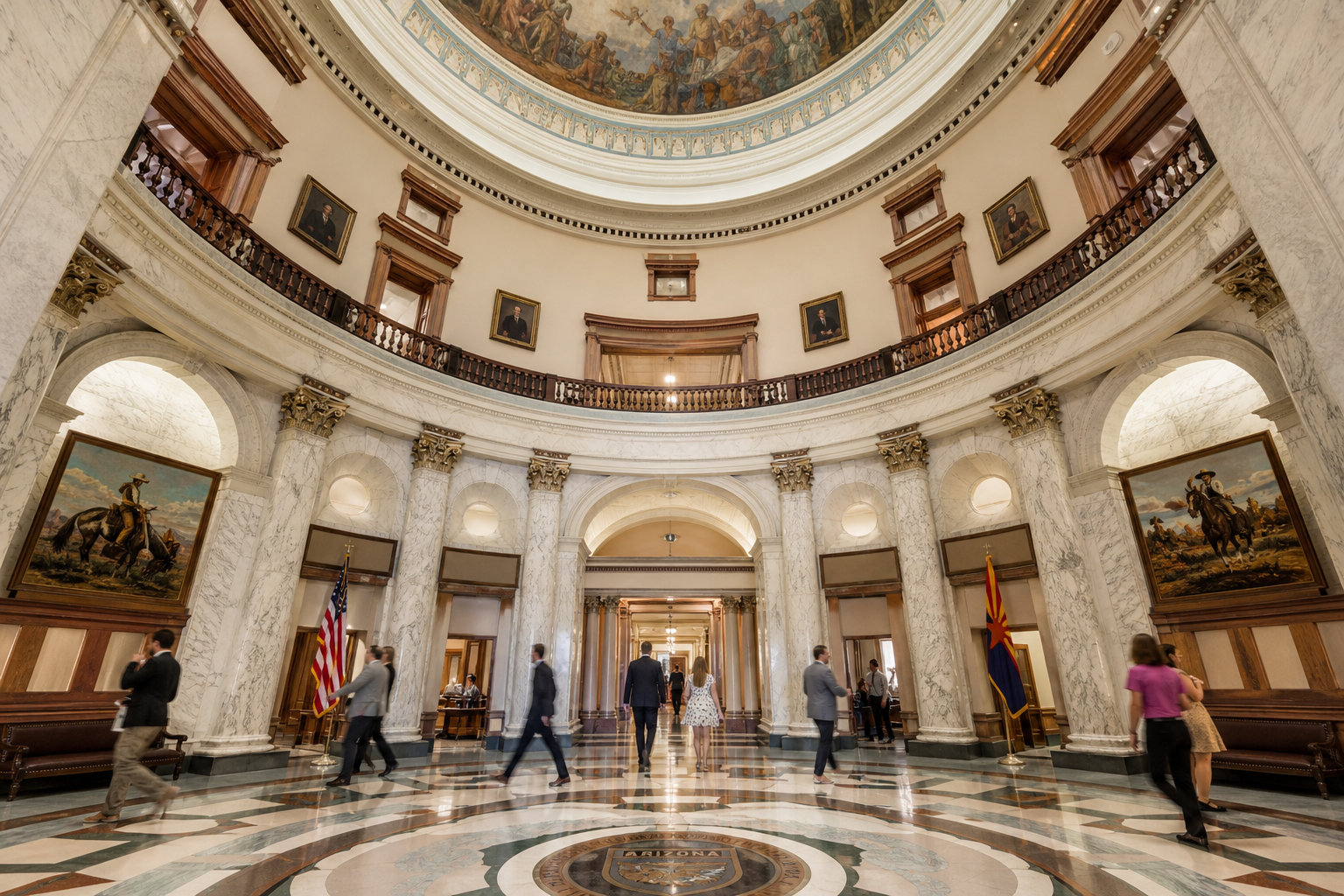
Arizona Democrats Take Full Control of State Government
Democrats now control the Arizona House, Senate, and governor's office simultaneously. The last time this happened was 1965. That is not a marginal shift in state governance. That is a structural change in what bills reach a floor vote and what bills do not.
The 2024 election gave Democrats 31 House seats and 16 Senate seats. Add gubernatorial control, and the math is unambiguous: Republican policy on three fronts—education, border enforcement, and water—faces headwind that did not exist in the previous eight years.
What Changes on School Choice
The Empowerment Scholarship Account program, Arizona's education savings account expansion passed under Republican governance, is now subject to legislative review by a majority that has consistently opposed school choice. The program allows parents to withdraw public funding and deploy it toward private school tuition, tutoring, or online education. Democrats have called it a threat to public school funding.
Expect bills targeting the program's expansion. The question is not whether they arrive—it is whether a Democratic governor signs them. Veto power remains the last republican tool in a trifecta.
That matters because Arizona's charter school population and private school scholarship holders represent real families with committed education decisions. Those decisions are now subject to legislative reversal in ways they were not before.
Border and Enforcement Policy at an Inflection Point
For eight years, Arizona governed its border posture through executive action and legislative cooperation. The state deployed equipment, authorized Joint Powers Agreements with counties, and coordinated with federal Border Patrol. It was not federal border control—the state cannot do that—but it was not passive either.
A Democratic majority and governor are unlikely to authorize funding increases for state-level border operations. The rhetorical posture will shift toward cooperation with federal law enforcement rather than state supplementation of it. Expect less state funding for technology, fewer agreements that empower county sheriffs, and messaging that emphasizes humanitarian response over enforcement.
Rural counties—Cochise, Yuma, Santa Cruz—will not stop feeling cartel activity or migrant pressure on infrastructure. The state's response will simply take a different form and reflect a different priority matrix.
Water Management and Groundwater Authority
Arizona's groundwater and Colorado River allocation law is administrative architecture layered atop statute. The 1980 Groundwater Management Act created Active Management Areas and regional governance structures. That law remains unchanged, but the agencies that execute it will face different appropriations and different board appointments.
Specifically, watch the Arizona Department of Water Resources. Board appointments and budget allocations shift the emphasis between agricultural interests and urban demands, between current extraction and long-term sustainability, between county-level sovereignty and regional planning. Those shifts happen quietly, but they carry the weight of statute.
Rural groundwater rights—the bedrock of agricultural Arizona—do not change by bill. They change by agency interpretation, funding priority, and enforcement emphasis. A Democratic administration is likely to weight conservation and sustainability more heavily than a Republican one did.
What Republicans Can Still Do
Majorities in a trifecta are powerful, but they are not absolute. Republican legislators can use minority amendments to force recorded votes on amendments that embarrass the majority. Roll-call votes are your document. They show which members voted for spending, which voted for restrictions, which members govern differently than their primaries.
Veto override requires a two-thirds supermajority—that is a higher bar than passage. If a Democratic governor signs legislation that alienates a subset of Democrats, override becomes theoretically possible. This is not a prediction. It is a reminder that the math moves both ways.
Local control offers another avenue. County boards of supervisors, city councils, and school boards remain domains where Republicans hold ground in purple counties. Those bodies control expenditures that do not appear in state budgets but affect local capacity to implement state policy. A county board can decline to participate in a state program. That does not overturn the program, but it fractures its implementation.
The Structural Question
Arizona has been a trifecta state twice in sixty years. The other instance was under Democratic governance in 1965. That interval suggests that unified control is not a permanent condition in Arizona. Redistricting occurs every ten years. Election dynamics shift. What looks durable now can fragment quickly.
That does not minimize what is happening now. It contextualizes it. This is a phase of Arizona politics, not the new permanent order. The question for conservative voters and legislators is not how to overturn it—that requires elections—but how to establish clear records and positions that survive it.
Mark March 2025 on your calendar. That is when early bills begin moving. That is when roll-call votes begin establishing records. Watch the voting patterns. Watch which Republicans show up and which do not. Watch which Democrats break ranks. Those votes are yours to review before the next primary.
