
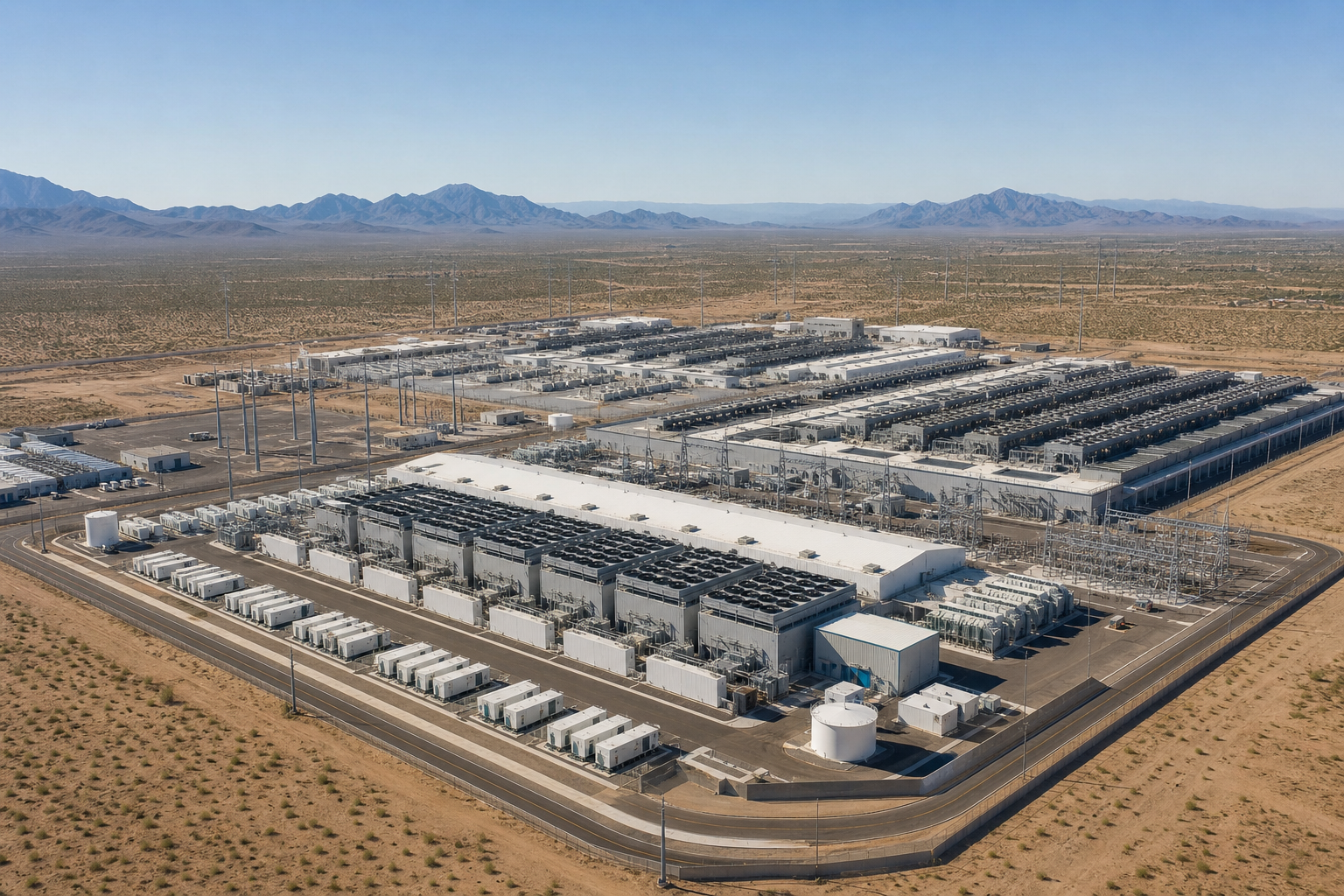
The Data Center Question Arizona Cannot Ignore
Arizona is becoming the nation's primary real estate for the companies building artificial intelligence infrastructure. That is a fact. The economic argument is straightforward: large, capital-intensive facilities mean property tax revenue, construction jobs, and long-term operational employment. Counties and municipalities have heard the pitch dozens of times in the last eighteen months.
It is also a fact that Arizona voters in multiple communities are now saying no, or at least not yet, and they are doing so with specific objections that deserve serious consideration rather than dismissal as Luddite resistance to progress.
Water and Power: The Real Constraints
Start with electricity. A large data center—the kind that houses thousands of servers running AI models—consumes as much power as a city of fifty thousand people. Not approximately. Not in peak hours. Constantly, twenty-four hours, three hundred sixty-five days a year. Arizona's power grid is already under stress during summer months. The Salt River Project and Arizona Public Service have begun infrastructure upgrades to handle this load, but those upgrades cost money and take time. That cost gets passed to residential ratepayers while the facility pays a negotiated commercial rate. You see the equation.
Water is the harder problem. A data center uses water for cooling—roughly one gallon per megawatt-hour in most modern designs, which sounds modest until you calculate the actual volume for a facility running continuously. In Cochise County, in Yuma County, in Pinal County, voters who depend on groundwater for agriculture and drinking water have watched the aquifer level decline for thirty years. They have watched well depths increase and pumping costs rise. They have watched dry years accumulate. The last thing a farmer facing groundwater depletion wants to see is a municipal water authority promising a technology company millions of gallons a year in a state where water is already allocated beyond sustainable supply.
The Sovereignty Issue
Here is what actually happened in several recent cases. A data center company approached a town council or county board. They offered local leaders a package: property tax revenue, perhaps infrastructure improvements, and vague promises about economic development. The elected officials negotiated. But the actual decision about water supply involved multiple layers of authority—the state Department of Water Resources, the active management area designation, sometimes tribal water rights, sometimes interstate Colorado River commitments. A town council cannot give away water it does not legally control, and that disconnect between local decision-making authority and actual water rights has become the fault line.
Voters are watching their representatives authorize projects that commit resources the representatives do not own. That is the real grievance. It is not opposition to data centers. It is opposition to the pretense that a county board can make a fifty-year commitment on behalf of residents who depend on groundwater for their survival.
What the Opposition Actually Sounds Like
Pay attention to what Arizona communities are actually asking for, because it tracks back to basic governance. They want impact studies that precede announcement, not follow it. They want water supply commitments grounded in hydrology, not optimism. They want to know the actual power draw before the contract is signed, not estimates. They want a voice in the process before the decision is made, not a comment period after.
In some cases, they are saying no for five years while studies are conducted. That is not opposition. That is due diligence. In other cases, they are proposing conditions: water must come from surface sources or recycled municipal supply, not groundwater. Power demand must be served by dedicated renewable capacity, not peak grid draw. Local workforce requirements. Cumulative impact assessments across multiple facilities, not individual facility review.
These are negotiable points, and they are reasonable points.
The Larger Pattern
Arizona has always been a state where decisions about growth got made in backroom deals between developers and elected officials, with the public finding out in the newspaper three months later. Water, power, land use—these were the domain of insiders who understood the technical complexity and acted accordingly. That model is breaking down because the stakes are visible now and because communities have learned to read the water law themselves.
Data center companies are not bad actors. They create value. But they are going to arrive at the table expecting the same procedural shortcuts that worked in 1995, and they are going to discover that Arizona voters in 2024 and 2025 have read the statutes and have questions. That is not hostile. That is democracy.
What Happens Next
Watch for three developments. First, expect data center proposals to shift toward Phoenix and Tucson where municipal water supplies are more diversified and power infrastructure is more robust. Second, expect facility designs to emphasize water efficiency and renewable energy partnerships as a compliance cost of doing business in Arizona. Third, expect the state legislature to revisit the groundwater statute that allows individual municipalities to commit water without cumulative impact review. That last one matters most.
The voters are not wrong about the constraints. The question is whether the state government can update its processes to match the scale of the commitments being made. If it cannot, the resistance will intensify. And it should.
